





Key Points
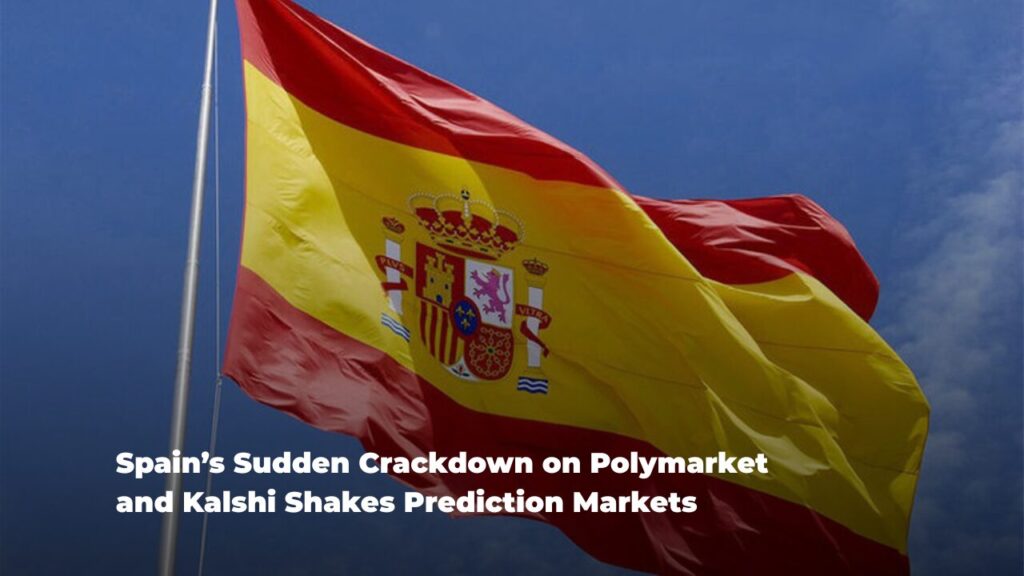
- Spain’s gambling watchdog moved to temporarily block Polymarket and Kalshi after opening formal sanction procedures against both firms. Regulators argued that the companies provided gambling services without securing the administrative approval required under Spanish law.
- Other concerns cited included those regarding consumer safety due to a lack of identification verification; weak measures to restrict access by minors and excluded users; and standards of regulation not meeting Spanish legal requirements.
- Spain now joins a widening international push against prediction markets. France, Brazil, Argentina, India, Indonesia, Germany, Belgium, Portugal, Switzerland, Romania, the Netherlands, and Poland have already taken action, while Malta and Gibraltar continue exploring regulated models for the sector.
Many users inside the prediction-market sector believed regulators still viewed these platforms as unresolved legal experiments. Spain delivered a different message. Authorities chose to block Polymarket and Kalshi outright, framing both companies as gambling operators that allegedly entered the country without permission rather than forecasting platforms or financial products.
That decision reaches far beyond two companies losing access to one market. A larger international conflict now sits in plain view, centred on who controls prediction markets and how governments intend to classify them. For traders, operators, and investors watching these platforms spread across elections, sports, economics, and world events, the regulatory risk suddenly feels impossible to dismiss.
Spain Places Prediction Markets Inside Gambling Law
A major legal question now sits at the heart of Spain’s crackdown, and regulators no longer seem willing to leave it unanswered. Officials are not approaching this as a routine licensing disagreement. Their focus has shifted toward defining what prediction markets actually are.
Spain’s Directorate General for Gambling Regulation, known as DGOJ and operating under the Ministry of Social Rights, Consumer Affairs and Agenda 2030, concluded that platforms allowing users to risk money on uncertain outcomes belong inside the country’s gambling framework. Under that interpretation, companies like Polymarket and Kalshi fall under Spanish gambling law instead of financial-market supervision.
That distinction could reshape the entire industry.
Prediction-market companies often describe their platforms as information networks where market pricing produces probability signals. Users trade positions connected to elections, sports results, economic data, cultural moments, and geopolitical events. Supporters regularly argue these systems differ from sportsbooks because prices reflect implied probabilities instead of fixed betting odds.
Spanish authorities looked past that framing and focused on how the platforms functioned underneath. Their reasoning revolved around one issue alone, people were placing money on uncertain future outcomes.
After regulators adopted that interpretation, the next issue surfaced quickly. Reports indicated neither platform possessed the administrative licences required to legally offer gambling services within Spain.
Why Spain Chose Immediate Restrictions?
The temporary block now operates as a precaution while formal sanction proceedings continue moving forward. Spanish regulators expect the investigation and final decision process to last between three and four months, leaving both platforms dealing with disruption during the review period.
Before making the notices public, authorities reportedly attempted to contact both companies through known overseas addresses. Those efforts failed. Regulators later published the notices through Spain’s Official State Gazette, the Boletín Oficial del Estado.
Behind the fast-moving action sits a wider concern governments now raise more often when dealing with offshore or unlicensed platforms. Spain placed consumer protection near the centre of its argument.
Authorities said unauthorised prediction-market operators may not provide safeguards required under Spanish law. Regulators pointed to missing identity checks, weak systems preventing access by minors, limited protections for self-excluded users, and supervision standards meant to reduce harm for consumers.
On the surface, those concerns may look administrative. A deeper regulatory shift appears underneath them. Governments are becoming less willing to treat prediction markets as technology products once real-money participation enters the picture. Instead, authorities increasingly apply the same standards already used for online casinos and sportsbooks.
Users begin feeling the impact almost immediately when that transition happens. Restrictions can disrupt liquidity, shrink participation pools, complicate deposits and withdrawals, and raise questions around whether existing positions or future activity remain legally protected.
Europe’s Split Over Prediction Markets Keeps Growing
Spain’s decision also exposes a widening divide across Europe, where regulators still lack a unified framework for prediction markets.
Several governments had already moved against Polymarket before Spain entered the debate. France blocked the platform in 2024 after authorities argued its operations likely conflicted with French law. Germany, Belgium, Portugal, Switzerland, Romania, the Netherlands, and Poland also introduced restrictions or outright blocks.
At the same moment, other jurisdictions started following a very different path.
Malta announced in March that officials were exploring regulation for prediction markets instead of banning them outright. Economy Minister Silvio Schembri said the government saw potential in building a supervised structure for the industry. Earlier this year, Gibraltar also granted a licence to its first prediction-market operator.
That divide reveals a deeper uncertainty spreading across Europe. Regulators still disagree on whether prediction markets belong under gambling law, financial oversight, commodities regulation, or a separate category that has not yet formally emerged.
For companies expanding across borders that lack of consistency creates rising instability. A platform accepted as a legal forecasting product in one country can suddenly face gambling enforcement in another.
International Pressure Continues Building
Spain’s crackdown did not appear in isolation. Across several regions, pressure on prediction markets has intensified in recent months as regulators increasingly move in similar directions.
Brazil blocked 27 prediction-market platforms, including Polymarket and Kalshi, after the National Monetary Council prohibited derivatives linked to sports, politics, social matters, cultural events, and entertainment activities.
Argentina ordered a nationwide restriction on Polymarket after raising illegal gambling concerns. Indonesia also blocked the platform once authorities classified it as online gambling under local law.
India followed a comparable route after regulators reportedly categorised prediction markets as prohibited online money gaming. That move triggered restrictions targeting Polymarket and reportedly affected Kalshi as well.
Viewed together, those developments point toward a broader industry shift. Governments no longer see prediction markets as small experimental platforms operating outside mainstream attention. The factors that prompted the development were financial growth, political influence, and cultural importance, thus placing the industry at the centre of regulatory attention around the world. The political aspect was possibly responsible for such pressure. With the advent of prediction markets in politics and finance, regulators had to determine their classification as either gambling sites, derivative products, or financial contracts.
Prediction Markets Face a Defining Identity Battle
Prediction-market firms keep up their defence of prediction markets as worthwhile tools for forecasting that use the power of crowd intelligence and market dynamics. Proponents often cite instances in which prediction markets have been better at forecasting elections, economic developments, or changes in public opinion compared to conventional polls.
Regulators, however, continue focusing on a different issue. Their attention increasingly centres on what protections exist once real money enters speculative event-driven trading. That conflict now stands directly in the path of the industry’s future. If governments classify prediction markets mainly as gambling products, operators could face licensing expenses, geographic barriers, tighter compliance demands, advertising restrictions, affordability checks, responsible-gaming obligations, and major operational limits.
A completely different system appears if regulators place these platforms under financial-product rules instead. That route introduces oversight tied to securities, derivatives, commodities, and trading-market regulation. Neither path offers an easy route toward worldwide expansion.
Users also face stronger consequences than many first expected. Many individuals have taken part in prediction markets under the assumption that these sites operate more as information markets rather than betting sites. A regulatory move will change their thinking in a hurry because classification matters for taxes, rights, payments, access, and reputation.
Expert Insight: What Comes Next for Prediction Markets?
Spain’s decision carries weight not only because of the temporary block, but because of the reasoning behind it. Regulators are signalling that prediction-market companies may struggle to expand internationally while bypassing local gambling or financial compliance systems.
That warning changes the financial equation for operators almost immediately.
Strategies relying on rapid growth overseas are increasingly under threat from licensing considerations, potential enforcement problems, geo-blocking requirements, and compliance mechanisms unique to each country. Small organisations may find these difficult to meet, whereas large enterprises might move towards licensing by jurisdiction rather than universal access.
On the other hand, the industry is likely to become more segregated along lines of regulation versus non-regulation. Those going for formal licensing could benefit from stronger links with banks and institutions, greater legitimacy, and enhanced trust among users. The other firms are likely to find themselves embroiled in endless fights against the law and liquidity problems.
Governments increasingly appear aware of the strategic importance tied to early intervention. Prediction markets now intersect with politically sensitive areas such as elections, economic forecasting, and public sentiment analysis. Regulators seem unwilling to leave those markets outside established oversight systems for much longer.
Users may eventually experience the biggest practical impact. Fragmented access could become routine, leaving platforms available in some countries while blocked elsewhere. Liquidity segmentation is another factor that could lead to reduced pricing efficiency, which forms the basis of the strongest justification for the efficacy of prediction markets put forward by proponents.
In the coming battle, issues of banning will take a back seat as concerns over categorisation become much more central. This decision could determine the future direction of the sector depending on whether prediction markets will be classified as gambling products, financial instruments, or some combination of both.
Explore more:
 Share
Share


 253 views