

Key Points
- New Jersey proposes strict bans, heavy penalties, and strong oversight for prediction markets linked to sensitive or harmful events.
- Consumer protection and public education form a central part of New Jersey’s regulatory strategy for allowed athletic event markets.
- Vermont adopts a narrower approach by clarifying illegality and adding fees, while still evaluating broader regulatory action.
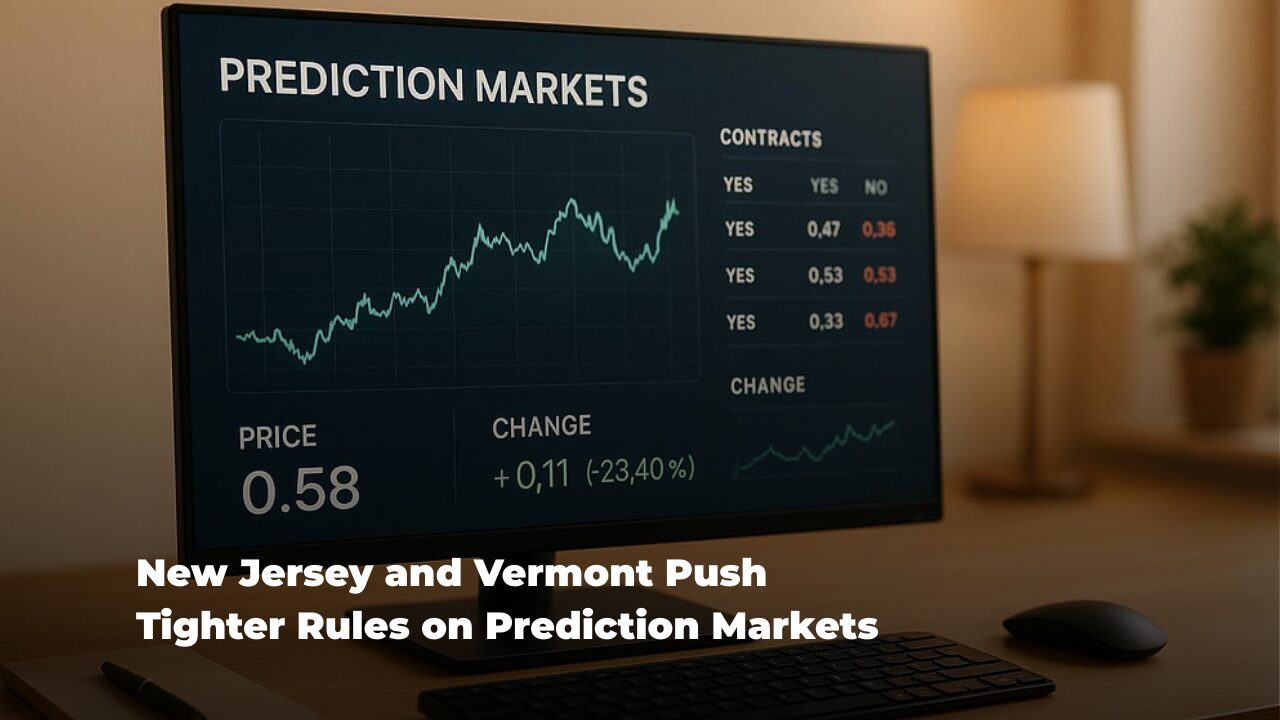
New bills from lawmakers in New Jersey and Vermont seek to restrict prediction markets and strengthen oversight of sports-related wagering activity across both states. Growing concern drives this coordinated push as states confront financial products resembling gambling that operate under federal commodities rules instead of state regulations. State authority must balance with federal law while regulators face expanding legal disputes with prediction market operators throughout the country currently. New Jersey’s Senate Bill 3692 arrived in the legislature on 24 February proposing clear limits on certain event-based prediction markets within state borders. Platforms allowing users to speculate on future outcomes face scrutiny while the bill establishes firm compliance rules for companies operating inside New Jersey.
Federal authority under the Commodity Exchange Act receives acknowledgement from lawmakers who still demand local compliance where no direct conflict exists legally. The proposal would ban markets tied to elections, wars, natural disasters, or death-related events from operating within state boundaries completely. Enforcement powers would belong to the Attorney General who could pursue court injunctions and impose penalties of one million dollars per day for violations. Despite restrictions, athletic event markets survive when operators possess proper sports wagering licences or establish partnerships with licensed entities in the state. Online sports betting standards would guide the Division of Gaming Enforcement as they oversee these operations and enforce compliance requirements consistently.
Consumer Protections and Public Awareness
Consumer safeguards and responsible gaming practices receive strong emphasis in the New Jersey bill extending beyond simple market restrictions for operators. All participants must prove they are at least twenty-one years old while operators provide self-exclusion options and deposit limit tools. Problem gambling helpline messages must appear visibly in advertising to support users developing harmful betting patterns requiring intervention or assistance. Online sports wagering tax rates would apply to approved athletic event markets with revenue entering the State General Fund for public use. The legal status of prediction markets and associated risks would become subjects of a public awareness campaign launched by state regulators soon. Reporting suspicious behaviour and accessing gambling support services would receive guidance through this educational effort reaching communities across New Jersey effectively.
House Bill 913 represents Vermont lawmakers’ more cautious approach after its introduction on 25 February and subsequent committee review assignment for consideration. Unlawful wagering clarification includes prediction market securities tied to sports, political campaigns, disasters, war, or death-related outcomes under the proposal. Such contracts would become void under state law while civil recovery of lost funds becomes possible for affected individuals seeking restitution legally. Licensed sports betting operators would collect a fifty-cent fee on each wager placed according to the bill’s additional provisions.
Explore more:
 Share
Share


 42 views






 Analysis
  Blog
Blog  Business
  Companies
  Crime
Crime  Finance
  M&A
M&A  Regulation
  Reports