Key Points
- The Nevada Gaming Commission unanimously approved Fertitta CFO Richard Liem and general counsel Steven Scheinthal on 23 July 2026, the most concrete regulatory step taken since the $17.6bn deal was announced in May.
- Neither company confirmed the transaction’s current status after the go-shop period closed on 11 July, raising questions about Carl Icahn’s rumoured counterbid.
- Fertitta’s general counsel predicted the Caesars deal would fold Golden Nugget into Caesars’ existing systems, including on AML compliance, despite Caesars’ recent $7.8m fine for failures tied to illegal bookmaker Mathew Bowyer.
Fertitta’s Men Get Licensed. Nobody Will Say If the Deal Is Still On.
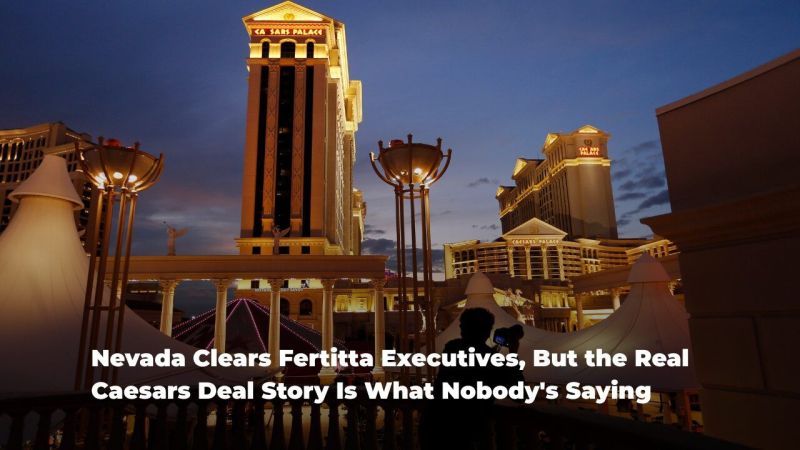
Two of Fertitta Entertainment’s most senior executives walked into the Nevada Gaming Commission chambers on 23 July 2026 and got what they came for. Richard Liem, Fertitta’s CFO, and Steven Scheinthal, its general counsel, were unanimously approved for licensing as the company moves to close its $17.6 billion acquisition and take-private of Caesars Entertainment. What they did not provide was anything resembling a clear update on whether the deal itself remains on track.
The all-cash transaction, announced on 28 May 2026, offers Caesars shareholders $31.00 per share. That figure represents a 49% premium over Caesars’ unaffected share price as of 25 February 2026, the last trading day before acquisition rumours surfaced. Yet two months on, both sides are saying next to nothing. Caesars declined to comment when contacted by iGB following the hearing. Liem, when pressed by commissioners about whether the deal was finalised after the go-shop period closed on 11 July, gave a carefully worded non-answer.
“I would say when it comes to Caesars, and that transaction, Caesars is a public company, and so Caesars will make whatever public announcements that they need to make,” Liem told commissioners.
The Go-Shop Window Closed. Carl Icahn’s Window May Have Too.
The silence matters because of what was circulating before the hearing. The billionaire activist stockholder Carl Icahn, whose relationship with Caesars is rather controversial, was allegedly putting together his own bid at the eleventh hour while the company was engaged in the go-shop process. The connection between Carl Icahn and Caesars is a long-standing one – the businessman was the one who orchestrated the $17.3 billion acquisition of Caesars by Eldorado Resorts in 2020.
By the time of the 23 July hearing, no competing bid had materialised publicly. Whether Icahn’s efforts collapsed or are still percolating behind closed doors is unclear. What is known is that two of Icahn’s representatives hold Caesars board seats, giving him continued visibility into what Fertitta and Caesars are doing. The Caesars board was reported to favour the Fertitta deal because of what sources described to CNBC as its “firm” financing, structured through a syndicate of 10 banks. Regardless, shareholders and the SEC proxy process still lie ahead before anything closes.
The Antitrust Gauntlet: Six Markets, One Federal Filing
Licensing is just one piece. The more complex obstacle is antitrust clearance. A Hart-Cottrell-Rodino filing has already been done at the Federal Trade Commission and that marks the beginning of a 30-day waiting period. Liem disclosed the filing but did not disclose any specific timeline as it depends on the individual case.
In terms of context, for example, he mentioned the deal to merge Paramount Skydance and Warner Bros Discovery valued at $110 billion, which eventually had to be paused midway into the process as the deal got blocked by a federal judge who imposed a temporary restraining order on behalf of 12 state attorneys general on antitrust grounds. While an enormous media merger is put on ice by legal action from states, a $17.6 billion casino merger has its own risks as well.
The Golden Nugget brand of Caesars and Fertitta shares common ground in six American markets, including three markets in Nevada – Las Vegas, Laughlin, and Lake Tahoe. After Eldorado Resorts purchased Caesars in 2020, divestitures of some assets were necessary for the approval of the merger. According to the Nevada Gaming Control Board, any decisions regarding competitive dynamics are dependent on federal antitrust law rulings. That sequencing means the FTC’s posture effectively controls the pace for everyone else.
Fertitta’s Ambassador Problem: Strategic Direction Without Operations
One of the more unusual threads running through the hearing was the question of who is actually running Fertitta Entertainment. Tilman Fertitta, the billionaire who built the company, has been serving as US Ambassador to Italy and San Marino since early 2025. Under foreign service ethics rules, he stepped back from day-to-day operations of the business, placing control with senior executives and his wife, Paige Fertitta.
Liem told commissioners the ambassador is “not involved in daily operations” but does provide “strategic direction,” a pairing of phrases that seemed to confuse at least some commissioners before the subject was dropped. Liem later clarified that Fertitta received clearance to retain some duties tied to his ownership of the NBA’s Houston Rockets, but not in gaming or hospitality. What “strategic direction” means in practice for a $17.6 billion acquisition being negotiated in his absence was left unaddressed.
Integrating into Caesars, Not the Other Way Around
Scheinthal proved the more forthcoming of the two executives, and the most useful insight he offered was on integration planning. He was unambiguous: Golden Nugget will absorb into Caesars’ systems, not the reverse.
“They’re much larger than us, the Caesars organisation, they have a tremendous number of people and it’s easier for us to integrate our properties into their system than it’s going to be for us to integrate their properties into our system, so that’s the plan,” he said.
That logic holds across employee benefits, IT infrastructure, and, most notably, anti-money laundering compliance. Caesars continues to cope with the aftermath of an AML fine of $7.8 million that it incurred in November 2025 as a result of its failure to comply with the rules regarding Mathew Bowyer, an illegal bookmaker. Bowyer used the properties of Caesars between 2017 and January 2024, when the firm considered him a “high-risk client” for five years but took no action until the authorities conducted a raid on his house. The fine of $7.8 million, which was three times larger than what Caesars won from Bowyer, was the third largest among the Las Vegas firms that were penalized.
Scheinthal was direct about Caesars’ remediation, suggesting the compliance overhaul already under way makes it logical to build toward their system rather than impose Golden Nugget’s on a much larger operation.
“I know that the Caesars organisation has had some historical issues in the past, but I do think it’s in the past with them,” he said. “They’ve got a tremendous department that they’ve put together, and ultimately it’s going to be easier to integrate into their system.”
He also noted that Golden Nugget has never had AML issues under Fertitta’s ownership, primarily because “we just don’t take the kind of play that would trigger a problem.”
Prediction Markets, Supreme Court, and Texas: Three Questions with No Clean Answers
Scheinthal used the platform to address three industry flashpoints, all of which go beyond the Caesars deal itself. On prediction markets, he acknowledged the competitive threat but predicted the question will eventually reach the Supreme Court. His view is that the court’s current composition, and its record of deferring to states’ rights, would likely favour state regulators over federal market expansion.
“I’m hypothesising, but if you look at who’s on the Supreme Court and their previous decisions and their relinquishment or deferral to states’ rights, you would think that would be the direction they would head in,” Scheinthal said.
In Texas, despite Fertitta’s deep Houston connections and his ownership of the Rockets, Scheinthal was sceptical that gaming expansion is imminent. Lieutenant Governor Dan Patrick has historically blocked such proposals, and with state elections not until 2028, Scheinthal put a two-cycle timeline on any realistic change.
“I do not envision that gaming would come to Texas based on current state politics,” he said. “Things can change, but if the current state politics stay the same in 2028, then you would say nothing will happen in Texas until state politics come back for election in 2032, and you would ask the same question then.”
The Culinary Union’s role also surfaced briefly. According to Scheinthal, “it was the union negotiations that led him to Las Vegas in his present capacity,” and further alleged that Fertitta had a “very productive relationship” with the Culinary Union, which he remembers getting a call from the Secretary-Treasurer of the Culinary, Ted Pappageorge, on the day of the Caesars announcement.” That relationship may matter considerably during integration, given Caesars’ large unionised workforce across its Las Vegas properties.
Expert Analysis: A Deal Still Waiting to Show Its Shape
The 23 July licensing approval moves Fertitta a step closer, but a step along a route whose length remains undefined. Antitrust review carries no set clock. Shareholder approval requires a proxy filing Caesars has not yet released. State-level gaming licence applications across all of Caesars’ jurisdictions have been split into two batches, with the second group still outstanding. The previous iGB reporting in July 2026 indicated Fertitta’s executives believed the full approval process could take nine to ten months from early July. At that pace, a close date in mid-2027 looks more realistic than late 2026.
The blackout of information on both ends due to Caesar’s publicly traded company status implies that the negotiation process is still ongoing as opposed to having come to a conclusion. The real issue at stake here is whether or not the deal gets done as it has been presented, gets restructured in a quiet manner, or meets an obstacle which it has yet to face. The only clear indication for now that the $17.6 billion deal is still alive is the regulatory boxes being checked in Nevada.
 Share
Share


 233 views