Key Points
- Ireland’s negotiations named 5 new EU revenue streams, and online gambling isn’t one of them.
- A gaming industry expert reckons a 3% levy would rake in about €1bn a year, roughly half the EU Commission’s estimate.
- EU Parliament groups are unlikely to back the budget without some new revenue, though they haven’t specifically targeted gambling as the solution.
The Gambling Levy Is Left on the Shelf
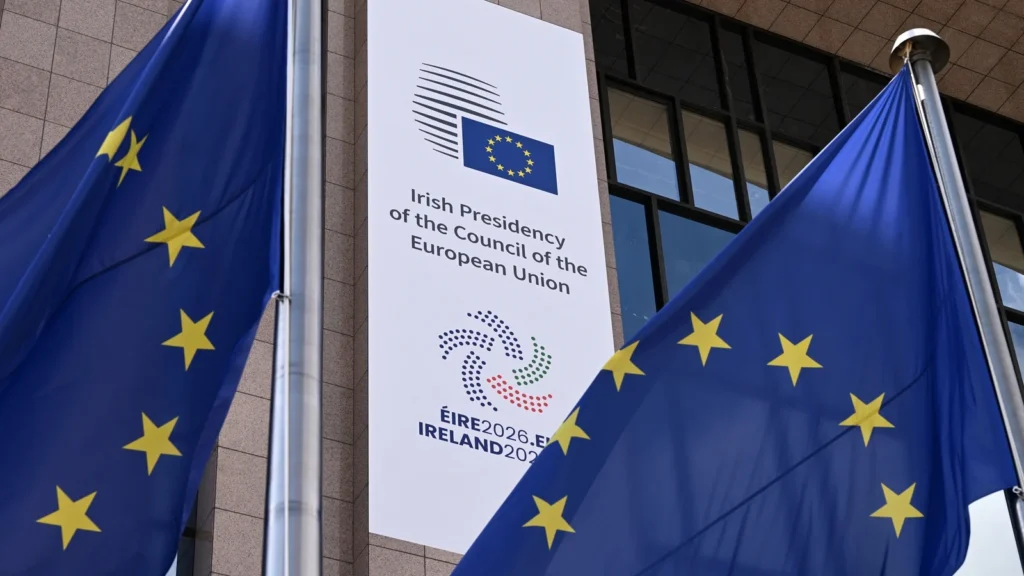
EU online gamblers have been watching Brussels with a growing sense of unease, would they soon be shelling out a bit more to the EU? When Ireland weighed in on 10 October, it got a bit of an answer. The country’s draft budget for 2028 to 2034 puts its own spin on the long-term budget and, get this, kicks the online gambling levy into the long grass.
The Irish Presidency’s budget proposal comes in at €1.62 trillion in 2025 prices, 8% or €141 billion lower than the EU Commission’s plan. It’s still 30% higher than the current budget, though. And in current prices, the total comes in at roughly €1.83 trillion.
We should say that the Commission never included the levy as part of its revenue plan, but the EU Parliament and France were pushing hard for it to be included nonetheless.
Ireland’s Alternative Revenue Plan
The draft budget currently rests on 5 “own resources”, i.e. money paid straight into the EU pot, not via the national treasuries. According to a reading of the text by European Gaming, these are:
- CORE, a contribution from big companies.
- A levy on tobacco.
- Uncollected electronic waste.
- A slice of the income from carbon trading.
- 90% of any carbon border receipts.
All of these items remain in square brackets as an indication that none have actually been agreed yet.
One little detail might interest operators, though, under CORE, companies with turnover higher than €100 million would be expected to cough up between €100,000 and €750,000 per year. That being said, it seems the larger operators might still have to contribute through another route.
Dublin reckons the package could bring in around €55 billion per year, though they admit member states are still split on the budget.
Byrne’s Three Tests Put the Kibosh on the Levy
So why did gambling get left behind, then? Thomas Byrne, the Irish Minister of State for European Affairs, had some insight into this on the day the draft budget dropped.
“We had three tests for new own resources,” he said in a chat with Euronews. “One, they must have unanimity. Two, they need to bring in a reasonable amount of cash. And three, they have to be ready to go from 1 January 2028.” The Parliament’s ideas failed to pass either of the first two tests, in his eyes.
A Levy Based on Uncertain Numbers
The concept was initially floated by Romanian MEP Victor Negrescu, who serves as a Vice-President of the European Parliament. Back in February, he proposed a tax of 1% to 2% on operators, estimating the proceeds to be between €2 billion and €4 billion a year. If the upper end of that range is reached, then the total would accumulate to close to €28 billion over seven years.
Later on, the Commission estimated a potential tax of 3% on net turnover, producing a more modest figure. As per SiGMA, that figure amounted to roughly €1.9 billion a year, with the main contributors being Spain, Poland, Germany, and Malta.
Ed Birkin, the managing director of H2 Gambling Capital, believes that even the latter number is overestimated. Talking to European Gaming in June, he put the revenue at just below €1 billion using 2026 figures. Birkin’s estimate does not include national lotteries’ online revenues and focuses on locally licensed operators only, but his judgment of the Commission’s research was quite clear nonetheless: “the starting figure is way off.”
The black market is yet another concern. According to Yield Sec’s research for the European Casino Association, the revenue from black market gambling operators in gross gaming terms reached €80.6 billion in 2024. That accounts for 71% of the entire EU online gambling market and more than twice as much as the revenue from the legal gambling industry’s €33.6 billion.
The Winners, The Losers and an Unexpected Lobby
Malta was the one country with the most at stake regarding this proposal. According to the Malta Gaming Authority‘s report, the sector contributed 6.7% to the country’s gross value added directly, while the indirect effect accounted for 10.1%. The Prime Minister of the country Robert Abela announced back in June that Malta wouldn’t accept any EU-wide taxes to finance its expenses.
European Gaming and Betting Association has stated in April that a levy of this kind is fundamentally unworkable. The reason is that in some countries, licensed operators already pay more than 50% of gross gaming revenue in taxes.
The horse racing industry joined the debate later and rather quietly. Shortly before the release of the draft, the European and Mediterranean Horseracing Federation wrote a letter to Byrne and the Finance Minister Simon Harris.
Parliament’s Leverage and the Road to December
The bigger budget is under pressure, which sustains the debate over revenue. German Chancellor Friedrich Merz explained that “the size of the proposal is not a basis for agreement,” while Sweden and the Netherlands called for more cuts.
MEPs are disappointed for the opposite reason. According to RTÉ’s Europe Editor Tony Connelly, a Parliament analysis says the draft “does not make tangible progress on new own resources.” The leaders of the EPP, S&D, Renew Europe and the Greens subsequently explained that they would refuse to support the budget unless there is an agreement on new revenue. This requirement relates to all new sources of revenue, not only gambling.
European leaders are meeting in Brussels on 15 and 16 October to discuss the budget. The summit will aim to agree on the key building blocks of a deal, but not on all details. An informal leaders’ meeting follows on 13 November, and a regular one on 17 and 18 December.
Political agreement is not the end of the road either. Under Article 311 of the Treaty on EU, new own resources need the Council’s unanimous approval. Each member state will then have to approve new own resources according to its domestic procedure.
Expert Analysis: Dublin Was Right, but Operators Should Hold the Champagne
In our opinion, Ireland acted correctly, and a veto threat by Malta is not the reason. A seven-year tax built on an estimate that may be twice as big as actual income is bad policy.
Nevertheless, we find it difficult to take Ireland’s prudent position as completely impartial. RTÉ reported that “long-term Irish defence of the national tax policy” could have reduced its ambition to create additional revenues for the EU. A government, which carefully protects its own tax base, would always be an awkward assessor of European taxation.
Celebrities among operators can enjoy their champagne now, but Parliament still insists on new money. Taxing gambling is much easier politically than a digital tax, which, as Ireland noted in its September paper, could cause a retaliatory strike from Washington.
We do not think that a gambling tax will come back soon, but if the frugal members continue reducing the budget and Parliament holds its veto, we would be surprised if the issue did not return before Christmas.
 Share
Share


 3 views