Key Points
- The tax remitted to the Federal Revenue by the licensed betting companies in Brazil between January and July 2026 amounted to R$8.7 billion (£1.2 billion), an increase of 76.86% compared to the previous year.
- Caroline de Toni, a federal deputy, has tabled Bill No. 5,153/2026 seeking an immediate cessation of betting licenses within 180 days, rendering the operation of such licenses illegal.
- Brazil’s own Finance Minister warned that banning betting would not stop it; it would simply send millions of players to the black market, beyond any state oversight.
The market that was illegal less than eighteen months ago is now issuing some of the biggest cheques to the government. The Brazilian legalised online betting market has contributed R$8.7bn (£1.2bn) to the Federal Revenue Service in January-July 2026, representing a 76.86% increase compared to the first seven months of 2025 when the market was opened on 1 January 2025. The market contributes more than £170 million per month to a government that does not like it.
The situation is not only embarrassing. It pulls in two directions and is exacerbated by the general elections in October.
The Bill That Would Wipe the Market in 180 Days
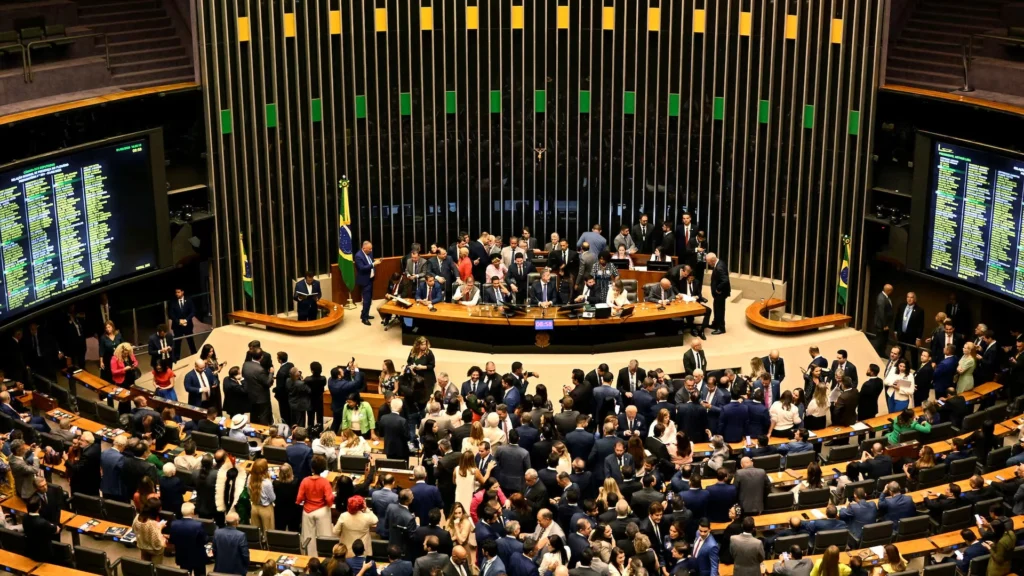
Federal Deputy Caroline de Toni of the Liberal Party filed Bill No. 5,153/2026 on 24 August, proposing to terminate every federal betting licence issued by the Ministry of Finance’s Secretariat of Prizes and Bets within 180 days. Operators would have 90 additional days to pay out prizes and return player balances. After that, continuing to run a fixed-odds platform would be a criminal offence carrying 2 to 5 years in prison, extended to anyone financing the activity or hiding who actually owns it.
The bill targets fixed-odds sports betting directly, the segment that drew international operators including Entain, Flutter Entertainment, Betano and bet365 into the market. De Toni cited Brazilian States’ Fiscal Bulletin data estimating a net outflow of R$65.5bn (£9.34bn) from Brazilian households to the betting sector, arguing that “the betting market has reached a sufficiently high economic scale to interfere with the consumption, savings, and debt decisions of Brazilian families.”
As of filing, the bill had reached only the Mesa, with no committee assigned and no date set for review. Most legislative proposals in Brazil’s Congress do not survive the committee process; this one faces the same odds. What it does do, however, is signal something more important than its likely outcome: both sides of the political spectrum now see betting as a vote-winner to oppose.
Left and Right, Same Enemy
The unusual part is not that one party wants restrictions. It is that two parties with opposite ideologies are arriving at the same destination.
President Lula signed the Bets Law in late 2024, creating the regulated market, despite what his Workers’ Party (PT) openly acknowledged as personal reservations. By August 2026, those reservations had become campaign material. On the Não Inviabilize podcast, Lula said: “If no one shows me a social reason for these betting operations to continue, we have to put an end to them.” Finance Minister Dario Durigan went further, confirming publicly that if the decision were Lula’s alone, he would have ended betting already.
From the right, Flávio Bolsonaro, the PL’s candidate for October’s election and son of former President Jair Bolsonaro, is reportedly weighing whether to include a betting ban in his manifesto. His VP candidate Alfredo Gaspar stated that Bolsonaro “does not yet have a definitive position on a total ban, but he does believe the regulation should be revisited to ensure it truly protects Brazilian families.” De Toni’s bill sits inside that same political framing.
When governing and opposition parties share a target, the industry cannot rely on political division for protection. That calculation has fundamentally shifted in 2026.
The Debt Argument Has a Crack in It
Both camps have built their case around household debt. Lula described the sector plainly on his podcast: “The tragedy of gambling is that you spend your whole life gambling to pay off the losses from the first game you played.” São Paulo’s Governor Tarcísio de Freitas, speaking at a health industry event, called for Brazil to end online betting entirely, stating: “Either Brazil ends gambling, or gambling ends Brazil.”
Yet the Central Bank’s own leadership quietly punctured the argument. Central Bank President Gabriel Galípolo, speaking at a trade show, attributed rising consumer debt primarily to credit card expansion, saying: “It’s not right to be happy with the news that credit has grown and then complain that debt has increased.” He made no reference to fixed-odds sports betting.
That is not a minor contradiction. It means the central institution responsible for monitoring Brazil’s financial stability does not see betting as the primary debt driver, even while politicians across the spectrum treat it as the obvious culprit. The debt narrative has political utility; the data behind it is considerably messier.
What a Ban Actually Costs the Government?
This is where the argument stops being about politics and starts being about arithmetic.
Federal Revenue Service auditors confirmed that the sector exceeded R$1.3bn in monthly tax contributions through most of 2026, with the H1 total reaching R$7.284bn, up 83.3% against the same period in 2025. At that pace, annual tax revenue from legal betting could surpass R$14bn before the year ends, more than 40% above 2025’s full-year figure of R$9.95bn.
Tax rates are also climbing. Operators moved from 12% to 13% gross gaming revenue (GGR) in January 2026. Legislation already passed will push that to 15% by 2027 and 18% by 2028, the result of December 2025’s Senate committee approval. A government planning to fund a multi-billion-reais housing reform and expanded social programmes has quietly built a meaningful dependency on a sector it publicly despises.
The caution from the Finance Minister Durigan must be re-emphasised – prohibition is not an end to betting but an end to regulated betting. Tens of millions of bettors don’t stop; they go to unregulated offshore websites that don’t contribute anything towards the Brazilian government in the form of taxes or regulatory fees.
The Signals the Market Is Sending
Beyond politics, two developments in August 2026 are worth noting for what they say about the market’s internal health.
More than 60 Brazilian news organisations signed a joint editorial refusing to accept betting advertising, citing conflicts of interest in covering a sector spending aggressively on media relationships. The mobilisation was described as unprecedented in Brazilian media history. Separately, the Federal Police raided Pixbet premises on 13 August as part of Operation Arena, with investigators alleging fraudulent use of deceased individuals’ tax IDs in illegal currency operations. A federal court in Paraíba ordered assets frozen up to R$1.1bn. The SPA suspended Pixbet that same day.
These events do not validate a blanket ban, but they do give critics hard evidence to deploy in committee hearings, and they make the industry’s defence considerably harder.
Expert Analysis: The Government Cannot Afford Its Own Position
We will say it plainly: the ban on conversation in Brazil is, for now, electoral theatre.
Consider what a ban actually requires. It requires Brazil’s next president, whoever wins in October, to surrender a tax pipeline that is on course to deliver R$14bn in a single year, to lose the economic activity generated by globally significant operators putting serious capital into the country, and to accept that millions of bettors will simply migrate to platforms with zero accountability to Brazilian families. Lula’s government is already running a R$300bn social spending commitment. Bolsonaro would inherit the same fiscal pressures with the same tools available.
Our reading is that the rhetoric and the reality are being kept deliberately separate for campaign purposes. The Durigan caveat proves it: Brazil’s own Finance Ministry understands the ban’s true cost while the President speaks publicly about ending the sector. That is not policy confusion. That is a government managing two audiences at once.
What is genuinely worth watching is not whether a ban passes, but whether the October election installs a government willing to use betting as a sustained political wedge even at the cost of the tax revenue. If that happens, the Pixbet scandal and the media revolt provide exactly the kind of public credibility cover needed to make the argument stick. The industry, right now, is more politically exposed than its tax contribution alone would suggest, and assuming fiscal logic will protect it is a bet that may not pay out.
Explore more:
 Share
Share


 199 views