





Key Points
- Boyd Interactive growth pushed management to raise full-year online EBITDAR guidance by $5m to a $35m-$40m range, even as reported online revenue fell year-on-year due to the FanDuel market access restructuring.
- Midwest and South operations delivered $556.9m in revenue, up 3.1%, carrying the quarter while Las Vegas Locals and Downtown continued to drag on overall results.
- Net profit attributable to Boyd fell 13.4% to $131.2m despite flat total revenue, with rising depreciation and project development costs squeezing margins.
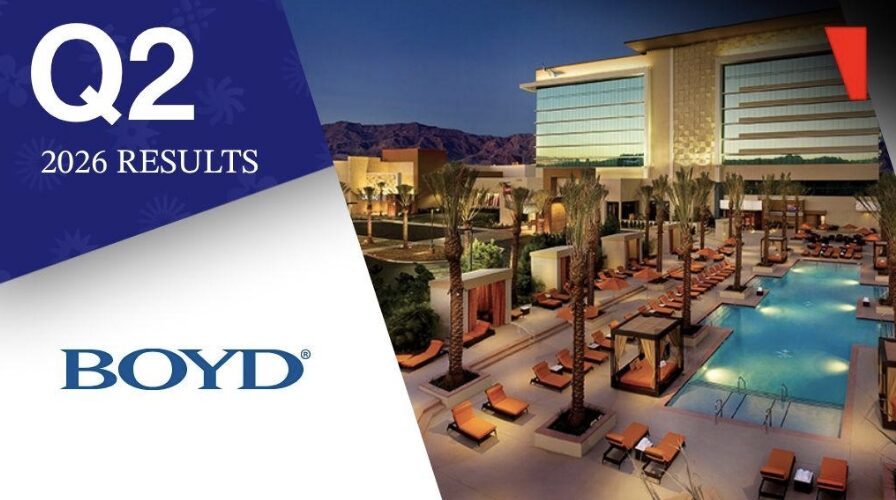
Boyd Gaming Lifts Online Guidance Despite Profit Squeeze — The Story Behind Q2’s Mixed Numbers
Boyd Gaming’s Q2 2026 earnings call produced an optimistic headline. Beneath it, the actual picture requires more careful reading.
On 23 July, the Las Vegas-based casino operator raised its full-year online EBITDAR guidance to a $35m-$40m range, following a quarter where Boyd Interactive, its proprietary digital platform, grew faster than management had projected. The $5m upward revision is modest in isolation; measured against Q1 2026’s online EBITDAR collapse from $23.3m to $8.4m, it signals something sharper — Boyd Interactive is generating real momentum.
Total revenues for the three months to 30 June 2026 reached $1.03bn, essentially flat against $1.034bn in Q2 2025. Net income attributable to Boyd dropped 13.4% to $131.2m, from $151.5m a year earlier. Group adjusted EBITDAR slipped 2.1% to $350.5m.
Online Revenue Fell on Paper — But the Comparison Is Misleading
The reported contraction in Boyd’s online segment revenue, from $173.1m down to $158.2m, unsettled some observers at first. CFO Josh Hirsberg dealt with this directly during the post-earnings conference call.
“As a result of Boyd Interactive’s strong performance, we are raising full-year guidance for our Online segment by $5 million to $35 million to $40 million for full-year 2026,” Hirsberg stated. A separate $3m lift to Managed business guidance also followed, moving that range to $113m-$117m on the back of Sky River Casino’s completed expansion phase.
It is distorted by history. In 2025, Boyd altered its agreements with FanDuel to generate recurring revenue in exchange for an upfront sum. That transaction inflated 2025 online revenue comparables. Strip it out and both online revenue and online EBITDAR grew in Q2 2026 on a like-for-like basis. Boyd Interactive is not in retreat; it is gaining ground, and the guidance revision is the clearest indication management has given that this trajectory is holding.
President and CEO Keith Smith pointed to two revenue pillars keeping the online business upright: approximately $12m annually from market access agreements, and direct growth from Boyd Interactive. “Our online segment achieved revenue and EBITDA growth on a comparable basis. These results reflected strong growth from Boyd Interactive as well as contributions from our market access agreements that were consistent with the last several quarters,” Smith said. Neither stream was showing stress in Q2.
Midwest Carries the Company Again; Las Vegas Keeps Slipping
The geographic split across Boyd’s land-based estate continues to widen. Midwest and South operations produced $556.9m in revenue for Q2, a 3.1% year-on-year rise, with adjusted EBITDAR reaching $208.7m, up 3.6%. Property margins for the segment expanded to nearly 38%, the strongest reading in roughly two years.
“This was the segment’s strongest margin in almost 2 years, demonstrating our continued ability to drive operating efficiencies throughout our business,” Smith told analysts. Higher gaming revenue from both core and retail customers powered the result, supplemented by returns from recent food and beverage capital investment.
Las Vegas remained a problem. The Locals segment posted $225.9m in revenue against $229.1m a year earlier; adjusted EBITDAR contracted from $112.7m to $106.4m. Renovation disruption at Suncoast and persistent destination softness at the Orleans pulled the numbers lower. Hirsberg placed the Orleans drag at approximately $5m of EBITDAR in Q2, flagging a similar $3m headwind for Q3. Suncoast construction disruption cost around $3m in Q2, with comparable pressure expected to continue.
Smith offered a cleaner read by isolating the affected properties. The Orleans and Suncoast aside, the other local estate in Las Vegas enjoyed a growth of 4% in revenue and 3% in EBITDAR. Downtown Las Vegas posted a decline in revenue by 1.4% to reach $52.1 million due to lower pedestrian and destination traffic.
Boyd’s Q1 2026 results, reported on 24 April, showed the same fault lines forming: Midwest and South revenue at $525.1m, up from $504.6m; Las Vegas Locals falling to $217.1m from $222.8m. The divergence is not new. What has shifted is its depth, with each successive quarter widening the distance between the two geographies.
Profits Under Pressure Despite Flat Revenue
Boyd’s Q2 income statement shows the cost of a heavy capital investment cycle feeding through to earnings. Operating expenses increased to $833.7 million from $791.6 million, while depreciation and amortization increased to $91.1 million from $70.0 million. Development, pre-opening, and writedown expenses increased to $15.4 million from $2.8m.
Operating profit fell 17.2% to $200.7m. Pre-tax profit dropped 11.7% to $170.6m. Net profit attributable to Boyd landed at $131.2m, down 13.4%, producing diluted earnings per share of $1.75 against $1.84 last year. Adjusted EPS of $1.93 topped the Wall Street consensus of $1.89. Revenue, though, narrowly missed the $1.048bn consensus forecast, per the official Boyd press release. Property operating margins held at 40% across the portfolio on a comparable basis, a level management has delivered consistently for several years.
“Quarterly results are based on both revenue and Adjusted EBITDAR growth, with operating margins for the properties at 40%. This is the kind of performance we have achieved consistently over the past few years,” commented Smith.
Total revenue for the first six months increased by 0.3% to $2.03 billion, whereas operating profit declined by 17.5% to $364.7 million, and adjusted EBITDAR decreased by 4.0% to $667.9 million.
Capital Commitments Build Towards a Larger Future
Boyd is deploying capital aggressively. The company restated its commitment to invest between $650 million and $700 million during the course of 2026, which will be spent on refurbishing the Orleans hotel, the recently launched Cadence Crossing Casino in March, the design of Par-A-Dice casino in Illinois, as well as the key project that will cost $750 million – the development of a destination resort in Norfolk, Virginia, expected to open by the end of 2027.
Boyd’s balance sheet closed Q2 with $322.7m in cash and $2.6bn in total debt. Over the quarter, the firm bought back $156m worth of shares, with $551m still available for share repurchase. Dividends totaling $0.20 per share were distributed on 15 July 2026. The management remained committed to the goal of returning around $150m each quarter to the stockholders, citing capital return of around $650m, or about $9 per share, for 2026.
“With our strong balance sheet, efficient operating model and robust free cash flow, our Company is well-positioned to continue creating long-term shareholder value,” Smith said.
Expert Analysis: What the Guidance Lift Actually Signals
The $5m raise to online EBITDAR guidance is not a transformative number for a business generating $1bn per quarter. What it represents is strategic confidence in Boyd Interactive at a specific point in its growth cycle. The FanDuel restructuring that distorted online comparables through 2025 and into early 2026 has now cleared; every incremental online EBITDAR gain from this point reflects Boyd Interactive’s own output, without the flattering cover of one-off payments running through the base period.
Las Vegas destination softness carries no quick resolution. Management has signalled multi-quarter headwinds at Suncoast and the Orleans, and nothing in the Q2 data suggests those pressures are easing. Rising depreciation from the capital investment cycle will continue to suppress reported net profit even as adjusted margins hold. The market’s measured response, with Boyd shares essentially flat in after-hours trading on 23 July, indicated that most observers accepted the adjusted framing. The more pressing question for the second half of 2026 is whether Boyd Interactive’s growth rate justifies the optimism embedded in the raised guidance, and whether the Midwest and South segment can continue absorbing pressure from properties that have been struggling for several consecutive quarters.
Explore more:
 Share
Share


 171 views