



Key Points
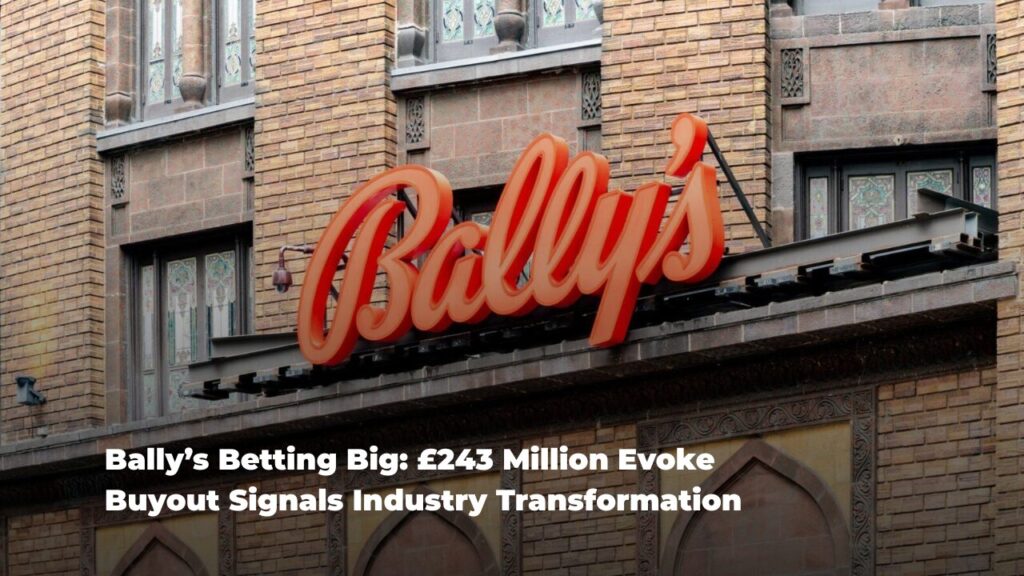
- Bally’s Intralot has agreed to buy Evoke through an all-share deal. The company is valued at £243.1 million, or 52p per share, a step up from the original 50p offer made in April.
- TPG Credit, Oaktree, and OHA have together committed roughly £889 million. That money will support the acquisition and refinance Evoke’s £1.86 billion debt. The deal is expected to close in Q4 2026 or Q1 2027.
- The combined group will sit second in UK iGaming and fourth in online sports betting, with management targeting £180 million in synergies each year.
The Deal That Took Six Months to Close
The morning of 5 June 2026 brought a confirmation that markets had quietly anticipated since winter. Evoke PLC announced that Bally’s Intralot, the Athens-listed gaming and lottery operator, had agreed to buy the company behind William Hill, 888, and Mr Green in a recommended all-share transaction valued at approximately £243.1 million. Three days stood between that announcement and the moment a firm offer deadline would have lapsed entirely.
What closed on that June morning had started in January 2026, when Bally’s Intralot first made an approach to Evoke’s board at 32 pence per share. By April, those talks had broken into the open. The offer on the table at that stage was 50 pence per share, putting Evoke’s value at around £225 million. A formal deadline of 18 May was set under UK takeover rules. That date came and went with no deal signed.
A three-week extension followed. Then, on 5 June, the final terms arrived: 52 pence per share, a revised valuation of £243.1 million, and a financing package from three private equity firms that dwarfs the actual equity price of the deal. The name above the betting shop door has not moved. By early 2027, though, the ownership behind William Hill will bear little resemblance to what it looked like at the start of this decade.
How a Tax Decision Became a Corporate Turning Point?
This decision didn’t start in June. No, it didn’t even start in April. To trace back the origins of this deal, one must go back to fall 2024 when the UK government announced its intentions to hike the Remote Gambling Duty by almost 100%. The Remote Gambling Duty will be increased from 21% to 40% before implementing an additional 25% Online Sports Betting Duty in 2027. For Evoke, already carrying a heavily leveraged balance sheet from its 2022 William Hill acquisition, those numbers did not leave much room to breathe.
Evoke put the annual cost of the change at somewhere between £125 million and £135 million every year. You do not absorb a figure like that. You make a decision because of it. The month after that duty announcement, in December 2025, Evoke launched a formal strategic review.
By that point, Evoke had already spent years absorbing hit after hit. Its valuation had fallen 90% from its 2021 peak. The UK Gambling Commission had taken multiple enforcement actions against it. A £19.2 million fine in 2023 followed, tied to social responsibility and anti-money laundering failings that the regulator called “widespread and alarming.” Running beneath all of this sat a debt load of approximately £1.86 billion, a burden built up through the £2 billion purchase of William Hill’s non-US assets from Caesars Entertainment back in 2022.
When the Remote Gambling Duty increase took effect in April 2026, Evoke moved at the same time to close approximately 270 William Hill betting shops, pointing directly at the tax changes as the primary reason. That same month, Bally’s Intralot’s approach became public. The timing was not a coincidence.
From £225 Million to £243 Million: How the Price Moved
When the approach first came to light in April, Bally’s Intralot framed it as a move built on scale. CEO Robeson Reeves put it this way at the time:
“We have built a business with a margin profile that stands out in this industry. Evoke has the scale. We see a compelling opportunity to bring our operating model to a significantly larger business, and the potential to transform its financial performance through massive synergies that we are uniquely positioned to deliver.”
That initial 50p-per-share offer sat roughly 29% above Evoke’s closing price before the approach was made public. It opened formal talks. It did not close them before the 18 May deadline. Three more weeks of negotiations followed, during which the price moved from 50p to 52p and the deal structure was refined. The final agreed terms include a partial cash alternative capped at approximately £117 million, alongside the main all-share route.
Shareholders who take the share option will receive 0.537 new Bally’s Intralot shares for each Evoke share they hold and will together own around 11.5% of the enlarged group. The 52p final price marks a 77% premium to Evoke’s three-month volume-weighted average share price before Bally’s Intralot disclosed its potential bid in April. Set against the 9 December 2025 closing price of 21.9p, that premium climbs to 138%. For context, Evoke shares have fallen more than 88% over the past five years.
What the £243 Million Figure Does Not Tell You?
The headline valuation is accurate. It is also only part of the picture. Evoke entered these talks carrying net debt of approximately £1.86 billion, inherited from the 2022 William Hill acquisition. Bally’s Intralot arrived with its own adjusted net debt of roughly €1.49 billion. Together, the two companies carry a debt load exceeding £3 billion, a figure that gets little attention in the headline number.
Three private equity firms stepped in to make the transaction work. TPG Credit, Oaktree, and OHA have together committed roughly £889 million in financing, set aside to support the acquisition and refinance Evoke’s existing debt. That figure is more than three and a half times the equity price of the deal itself. Ben Robinson, founder and managing partner of advisory firm Corfai, told iGB the combined debt was being “underpriced” in how markets were reading the deal. Two words; they cut through the announcement language considerably.
What the Chairmen Said, and What They Did Not?
Three executives went on record in support of the deal on 5 June. Not one of them spoke directly to the combined debt position. Evoke chairman Mark Summerfield framed the outcome as the most workable solution to a deeply constrained set of options:
“The combination will create one of the world’s leading online betting and gaming groups with superior scale, exceptional brands, increased diversification and a platform for strong growth through enhanced capabilities. I’m confident Intralot will be a strong and supportive owner of the business, and together with the more sustainable capital structure, the combination offers the best route to deliver long-term value for our shareholders and broader stakeholders.”
Bally’s Intralot board chairman Sokratis Kokkalis described the moment as a turning point:
“Today marks the beginning of a major new chapter for our company with the submission of a binding offer for the acquisition of Evoke aimed at creating a very strong global player in the gaming industry. This move demonstrates the new momentum our company has gained, justifying the trust shown to us by the investment community.”
Bally’s chairman Soo Kim added:
“Underpinned by the combination of Evoke’s iconic brands of incredible heritage, such as William Hill and 888, with Bally’s Intralot’s best-in-class technology and data capabilities, highly executable synergies and the ability to invest our substantial free cash flow in growth markets, we are confident that the enlarged group will not just be stronger than before, but stronger than ever.”
Three chairmen spoke. Three declarations of confidence followed. The phrase “more sustainable capital structure” in Summerfield’s statement was the nearest any of them got to naming what the financing package actually looks like beneath the surface.
The Combined Group, on Paper
On paper, the enlarged entity will cover six core markets within a total addressable market of €36 billion. It will immediately become the second-largest operator in UK iGaming, sitting fourth in online sports betting across the country. Management has projected annual cost and capital expenditure synergies of approximately £180 million, alongside better EBITDA margins and stronger cash generation. New shares will be admitted to trading on Euronext Athens; Evoke will delist from the London Stock Exchange.
Bally’s Intralot itself was formed in October 2025 through the merger of Athens-based Intralot and Bally’s Corporation. By Reeves’ own account, the Evoke acquisition is worth roughly seven years of organic growth. He put it plainly:
“We’ll be number two in the UK, we’ll be pretty large in other markets, but there’s a big old planet where we can still expand into. We want to have diversified income, so we’ll definitely be looking at which markets we spend our money in. I’m definitely looking at this as giving us a pathway for further expansion.”
The Asset Sale Question
The most revealing moment came when Reeves was pressed on whether the combined group would sell assets to bring its leverage down. His answer was, on the surface, a refusal. Look closer, and it reads differently.
“If someone offered me a billion for [the] Denmark [business], I’d sell. Sometimes when you say ‘I won’t sell something’, and someone offers you a knockout price which is ridiculous, you take it anyway.”
In Italy, which Corfai’s Robinson had singled out as an obvious disposal candidate alongside Mr Green, Reeves was more resistant:
“People will talk to me and say, ‘Why don’t you sell Italy?’ or something like that. Italy is one of the prized assets, probably one of the things I’d refuse to sell.”
The gap between “no current intention to sell” and “would sell Denmark for the right price” is not a contradiction to simply set aside. It is a guide to where the pressure will likely build next, particularly sitting on £3 billion in combined debt, in a sector already grappling with rising taxes, tighter regulation, and persistent compliance obligations.
Market Reaction: One Day Up, Three Days Later Down
Evoke shares surged 16% on 5 June, climbing to 46.45p and reaching their highest point since October 2025. For a brief moment, the stock sat as the strongest performer on the FTSE Small Cap index. By 8 June, EVOK.L had slipped 2.17%, with BYLOT.AT down 1.95% on the same session. That opening surge was, at its core, relief; relief that months of drawn-out uncertainty had finally produced an answer.
Expert Analysis
Ben Robinson of Corfai remains the only named independent analyst to have spoken publicly about the deal. His view was precise rather than broad: the combined debt was being “underpriced.” That said, the structural logic behind the transaction does have grounding. A near-doubling of the Remote Gambling Duty puts pressure on every licensed UK operator; it also pushes smaller, more financially exposed players towards the exit. A combined group with real scale can absorb regulatory costs that would break a standalone operator.
Evoke’s own recent trading had also shown signs of steadying. Q4 2025 revenue came in at approximately £464 million, up 7% quarter over quarter, its best quarterly result of the year. If that direction holds, it supports a turnaround story rather than a pure distress sale.
What Comes Next?
Before this deal closes, it needs approval from Evoke shareholders, Bally’s Intralot shareholders, the UK Gambling Commission, and regulators across the other markets where the combined group will operate. Completion is expected in Q4 2026 or Q1 2027. For Evoke shareholders, the immediate call is whether to take the share alternative, accepting 11.5% of a heavily leveraged combined business, or the capped cash option at 52p; bearing in mind that allocations may be reduced if demand runs past the £117 million cap.
For the staff at the William Hill shops that survived April’s closures, and for the customers who still walk through their doors, the question is far simpler, though it will take much longer to answer: will the new owners put money into what they have bought, or will they treat it as something to be trimmed and managed down? That answer will not come with the regulatory approvals. It will come in the quarters that follow them.
Explore more:
 Share
Share


 313 views