

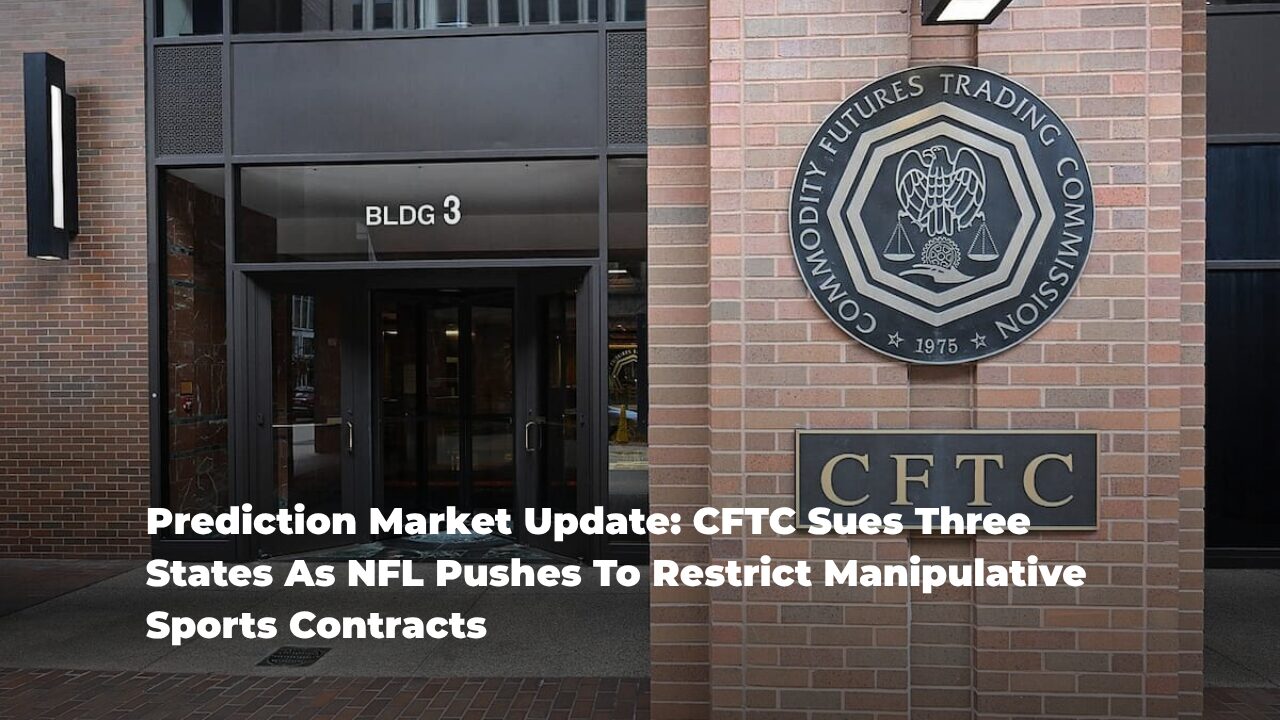
CFTC Chair Michael Selig has taken a central role in a growing legal and regulatory battle over prediction markets. The agency has filed lawsuits against Illinois, Arizona and Connecticut, challenging state actions against federally registered platforms.
The CFTC argues that event contracts fall under its exclusive authority through the Commodity Exchange Act. Its position is that states cannot impose separate gambling regulations on these markets.
“This is not the first time states have tried to impose inconsistent and contrary obligations on market participants, but Congress specifically rejected such a fragmented patchwork of state regulations because it resulted in poorer consumer protection and increased risk of fraud and manipulation,” Selig said.
In its filing, the agency pointed to cease-and-desist orders issued by the Illinois Gaming Board against federally registered platforms. It argued that states “misapprehend” the structure of event contracts and the federal framework governing them.
“Even without the express language of the CEA preempting state regulation, any state interference in DCM regulation is preempted because Congress “occupied the field” via the CEA and the CFTC,” the agency wrote.
The lawsuits mark the first time the CFTC has directly moved to block states from enforcing gambling laws against prediction market operators.
NFL pushes for restrictions on high-risk event contracts
The National Football League has increased its engagement with regulators as concerns around market integrity grow. In a letter sent on 29 March, the league urged operators to avoid listing “inherently objectionable” contracts on officiating decisions, injuries and other sensitive areas.
League officials have held discussions with the CFTC on contracts potentially vulnerable to manipulation. According to Selig, contracts linked to player injuries are likely to face rejection due to the risk of financial incentives influencing on-field behaviour.
“The CFTC takes seriously its responsibility to reject prediction market contracts that are readily susceptible to manipulation and we’re working with the professional sports leagues to ensure we get this right,” Selig told ESPN.
The NFL previously suspended former New Orleans Saints coach Sean Payton for the 2012 season after an investigation found a system rewarding players for injuring opponents.
The league initially resisted involvement in prediction markets, with executive Jeff Miller warning of the “possible impact on the integrity” of games. More recently, the league has described event contracts as “innovative” while pushing for safeguards.
Enforcement focus expands to insider trading risks
The CFTC is also addressing concerns around insider trading within prediction markets. David Miller warned that violations could lead to prosecution.
“A myth has spread that insider trading is permissible [as] prominent individuals in finance have contended that insider trading law does not apply to these markets,” Miller said. “These comments all suggest that insider trading is an important and acceptable part of the prediction market ecosystem — not so.”
The issue gained attention during the Super Bowl, where unusual trading patterns raised questions about access to privileged information. Speculation around event outcomes, including entertainment elements and attendee appearances, highlighted how sensitive information could influence market activity.
Regulators are focusing on contracts where information asymmetry could create unfair advantages. The aim is to align prediction market oversight with standards applied to traditional financial markets.
Tribal opposition intensifies as industry debate widens
Tribal gaming groups have escalated their opposition to prediction markets, framing them as a direct threat to existing regulatory structures. The issue dominated discussions at the 2026 Indian Gaming Tradeshow and Convention, which opened on March 30 with four sessions on prediction markets.
Indian Gaming Association Chair Victor Rocha organised multiple sessions on the topic, describing prediction markets as an “existential threat” to tribal gaming.
Industry leaders are pushing for restrictions on sports-related event contracts, arguing that they undermine established gaming frameworks. David Bean said legal outcomes will likely determine the direction of the sector.
“I feel really strongly that we will prevail,” he said. At a separate briefing, Bean added: “This is about fairness, this is about protecting our industry. We will not allow federal agencies to ignore our laws.”
The debate has drawn political attention. Senator Richard Blumenthal criticised the CFTC’s legal intervention, accusing the agency of favouring prediction markets.
“He’s shown himself a crony of Kalshi, using the CFTC to bully states on their behalf,” Blumenthal wrote.
Explore more:
 Share
Share


 40 views




 Analysis
  Business
  Companies
  Crime
Crime  Finance
  M&A
M&A  Prediction Markets
  Regulation
  Reports