






Key Points
- Polymarket reopened US iOS access, allowing users to trade event contracts without invitation codes or waiting lists after a long-restricted rollout stage.
- The return became possible after its $112 million QCEX acquisition restored infrastructure aligned with CFTC rules following a $1.4 million penalty and years of offshore activity.
- Even with rising trading activity and growing public attention, Polymarket still remains behind Kalshi in the US market control while regulatory uncertainty continues shaping the sector’s direction.
What happens when a platform once removed from the United States suddenly appears again across millions of iPhones without much noise, yet still changes market behaviour? That moment now surrounds Polymarket, and people following betting or crypto markets are watching the timing with attention.
For users, this shift does not arrive through a loud relaunch announcement because access now opens in a way that feels direct and immediate. After years of regulatory pressure and restricted operations, the platform no longer stands partly closed because it now allows US participation in a form changing how mobile prediction markets are experienced.
US iOS Access Opens Again
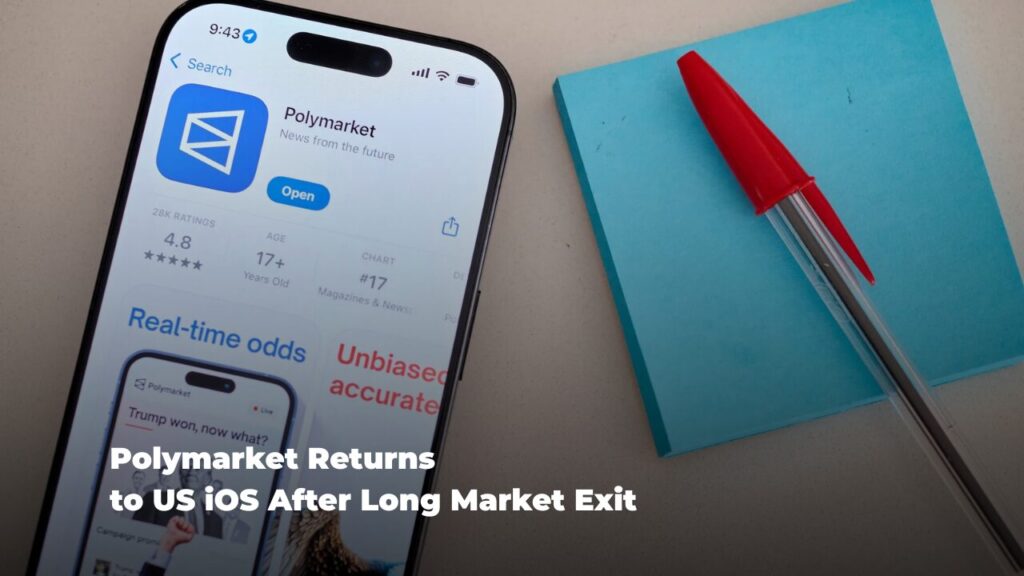
Polymarket officially opened its United States exchange on iOS, allowing Apple users to trade event-based markets through a mobile application without invitation codes or waiting lists. A system once limited to a six-month invitation-only pilot has now moved into open onboarding for US users.
During the earlier pilot phase, most users remained outside the ecosystem because access stayed narrow and controlled. Now, onboarding moves directly into a live trading interface where participation starts immediately.
Inside the platform, users can engage in event markets linked mainly with sports outcomes through a mobile structure built to mirror desktop functionality. Features including biometric login, push notifications, and swipe-based market discovery now form part of the experience, helping users move through markets with less interruption.
Even after the reopening, expansion still remains incomplete. Android access has not been announced, while full web-based access continues to be limited under changing rollout conditions, leaving platform reach uneven despite the comeback.
Regulation and Legal Structure Behind the Return
Behind this renewed access sits a controlled regulatory framework continuing to shape every move connected with the platform. The Commodity Futures Trading Commission treats prediction market event contracts as financial derivatives, classifying them as swaps or futures under federal oversight.
These contracts cover sports outcomes, political events, cryptocurrency movement, and global affairs. Users trade “yes” or “no” positions while prices continue shifting according to probability and market sentiment.
The legal situation, however, still remains unresolved. Some states attempted to classify these contracts as gambling products, while federal regulators resisted fully accepting that interpretation. In places including Minnesota, bans have already entered force, forcing platforms such as Polymarket to rely on geofencing systems blocking restricted areas.
Regulation also continues evolving through enforcement rules including CFTC Rule 40.11, which blocks contracts considered against public interest. Those restrictions extend toward markets involving injuries or assassinations, showing how some sectors remain tightly controlled while others continue sitting inside legal interpretation.
QCEX Deal Changes Polymarket’s Return to the US
The turning point behind Polymarket returning to the United States came through its $112 million QCEX acquisition in July 2025. That agreement brought a CFTC-licensed exchange into the company, providing the regulatory structure needed for re-entry into the US market.
Through this acquisition, Polymarket gained status as both a Designated Contract Market (DCM) and a Derivatives Clearing Organisation (DCO), rebuilding the legal foundation required for operating inside the United States.
This situation marks a shift from the company’s earlier position. Back in 2022, Polymarket faced enforcement action and received a $1.4 million penalty for offering unregistered derivatives. Although the company cooperated with investigators, which reduced penalties, the outcome still pushed operations offshore while global trading activity continued.
Following restructuring, Polymarket also secured futures commission merchant (FCM) status, strengthening its compliance structure and allowing formal participation inside US event contract markets.
Trading Activity and Market Competition Continue Rising
Even during restricted access, trading activity never disappeared fully. Some users still reached the platform through VPN systems while participating in events including March Madness and The Masters, where trading volume increased during sports periods.
When phased US access returned, activity started increasing again in visible stages. Early participation remained limited at first, but later expanded into tens of millions of dollars during NCAA basketball tournaments and golf championships, reflecting demand across the market.
Despite that growth, competition inside the sector remains intense. Polymarket describes itself as the largest prediction market platform by trading volume, yet it still remains behind Kalshi, which controls around 90 per cent of US market activity. Other companies including Crypto.com continue operating in the space but at a smaller level.
At the same time, valuation signals reveal the market gap. Polymarket reportedly seeks funding at a $15 billion valuation, while Kalshi stands at $22 billion, showing both movement and distance between market positions.
Prediction Markets Move Toward Wider Adoption
Across the United States, prediction markets continue moving closer toward financial and betting systems used by larger audiences. Rising participation suggests users now treat event-based trading less like traditional wagering and more like structured forecasting linked with real-world outcomes.
This movement appears most clearly through sports-linked contracts, where participation patterns resemble betting behaviour while remaining structured under financial contract systems. As user participation expands, analysts continue expecting growth in this hybrid market.
Even so, concerns continue to appear. Questions involving accessibility, especially around younger users including Gen Z audiences, continue surfacing beside debates linked with exposure risks.
For regulators, the challenge goes beyond oversight because classification remains the larger issue. The central problem focuses on how decentralised-style platforms fit inside existing systems without removing the separation between gambling and financial derivatives.
Expert View on What This Change Means
Polymarket’s return to US iOS access reflects less about launching another product and more about prediction markets moving into formal financial oversight systems. The immediate effect becomes structural because compliance costs increase under CFTC-aligned systems, yet access to US liquidity becomes more stable and scalable in return. That balance already appears visible through the QCEX shift, where regulatory infrastructure replaced offshore flexibility.
The wider industry response also continues to become clearer. Competition now intensifies between regulated platforms instead of experimental decentralised systems. Kalshi’s market control shows how compliance-first strategies can secure leadership, while Polymarket’s global reach and brand recognition suggest another layer of competition forming underneath. The outcome becomes a fragmented ecosystem where legitimacy now matters as much as innovation.
Growth opportunities continue to remain strongest in retail participation, especially inside sports-driven markets mirroring mainstream betting behaviour while operating through financial contracts. Still, risks continue to exist around tighter regulation and changing interpretations involving user protection and sensitive outcomes, especially concerning younger audiences.
What happens next depends heavily on regulatory clarity across federal agencies and states. If definitions become more aligned, platforms such as Polymarket could expand into larger financial forecasting tools. If uncertainty continues, fragmentation and geofencing will likely remain part of the user experience, limiting nationwide integration despite rising demand.
 Share
Share


 380 views