

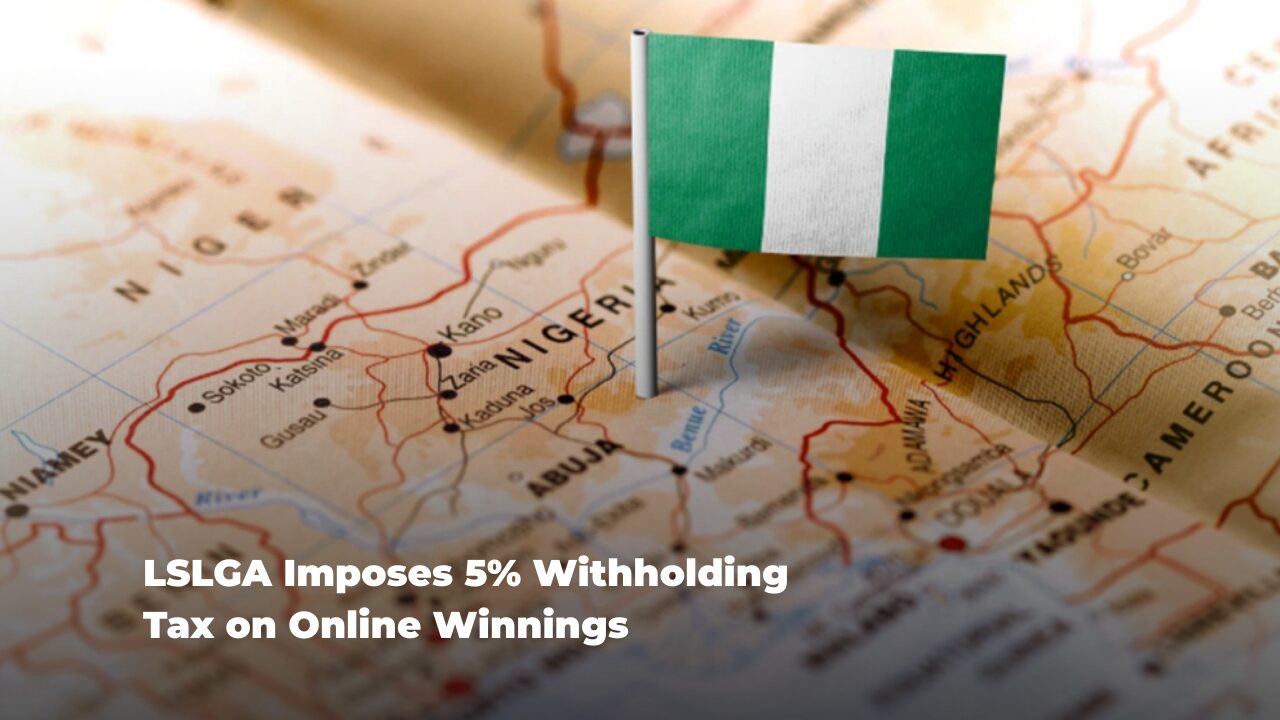
The Lagos State Lotteries and Gaming Authority (LSLGA) has imposed a 5% withholding tax on net online betting winnings. This directive took effect upon announcement through a public notice.
Chief Executive Officer Bashir Are confirmed that the tax will be applied at payout across every Lagos-licensed operator, whether the player resides in the state or not. Withheld funds will be transferred directly to the Lagos State Internal Revenue Service.
Policy Aims to Strengthen Compliance in Expanding Market
The authority stated that the tax forms part of an effort to improve tax compliance, transparency, and accountability within Nigeria’s fast-growing gaming sector. Online betting activity has increased rapidly in recent years, with participation fuelled by digital platforms and a young, tech-savvy population.
Nigeria’s legal gaming landscape includes sports betting brands, such as Bet9ja and BetKing; lotteries, casinos, and promotional competitions.
LSLGA reiterated that operators must be registered with the Corporate Affairs Commission and hold a valid state licence. Lagos remains the country’s commercial centre and accounts for a substantial share of regulated gaming activity. Policymakers often test new regulatory measures in the state.
At the federal level, the National Lottery Act of 2005 and the National Lottery Regulation of 2007 provide the primary statutory framework. Individual states maintain their laws governing gaming and taxation. In Lagos, oversight is anchored in the Casino and Gaming Regulatory Authority Law and the Lagos State Lottery Law, amended in 2008.
Conversely, regulation in Anambra State relies on its Gaming Law of 2005. In 2024, the Supreme Court of Nigeria affirmed that states hold primary jurisdiction over gaming within their territories.
Fragmented Oversight After Central Bill Rejected
Nigeria does not operate under a unified national gaming code. In December 2025, President Bola Ahmed Tinubu declined to sign the proposed Central Gaming Bill, which aimed to consolidate supervision under a single federal commission.
Therefore, states continue to exercise independent authority, resulting in regulatory inconsistencies. Operators navigating multiple states must account for distinct tax rules and compliance procedures.
Observers cited by local media have warned that higher withholding obligations may encourage migration to offshore platforms. Unlicensed operators often avoid domestic tax requirements, which could reduce projected state revenue collections.
Regional Comparisons Highlight Divergent Tax Models
Other African jurisdictions apply varying approaches to taxing gaming activity. Kenya imposes a five percent withholding tax on withdrawals and applies a five percent excise duty on deposits.
However, South Africa has proposed a 20 percent withholding tax as part of efforts to address problem gambling. Ghana taxes operators at 20 percent Gross Gaming Revenue and previously repealed a winnings tax following public debate.
These contrasting models illustrate differing policy priorities. While Kenya and Lagos focus on revenue generation, South Africa tackles social concerns and Ghana’s repeal prevents public backlash.
For Lagos, implementation will test whether collection efficiency can be maintained without diminishing participation in the regulated market.
Explore more:
 Share
Share


 46 views







 Analysis
  Blog
Blog  Business
  Companies
  Crime
Crime  Finance
  M&A
M&A  Regulation
  Reports