Key Points:
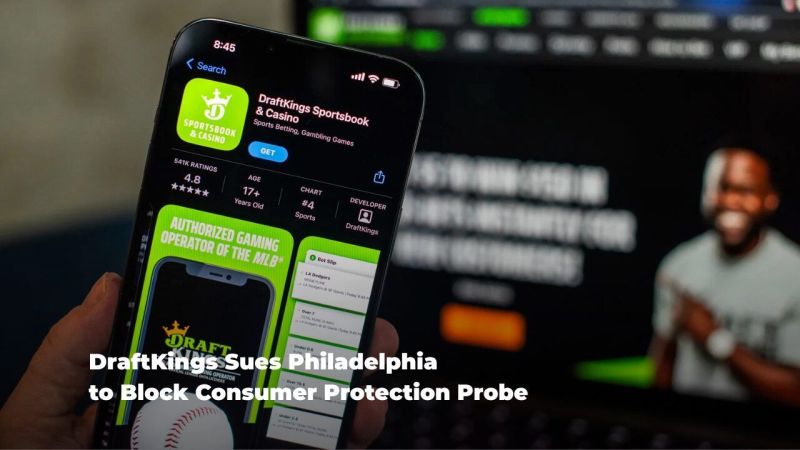
- DraftKings, Crown PA Gaming and Golden Nugget Online Gaming filed a federal complaint on 16 July challenging Philadelphia’s 2024 Consumer Protection Ordinance.
- Philadelphia’s April subpoena demanded records on wagering revenue, VIP programmes, promotions and responsible gambling practices.
- DraftKings warns the city confirmed on 9 July it was preparing a civil enforcement action, which the company calls a direct overreach of state authority.
DraftKings Draws a Legal Line Against Philadelphia’s Probe
Philadelphia and DraftKings are now in federal court, and the dispute goes well beyond one subpoena. On 16th July, DraftKings filed a lawsuit at the U.S. District Court of the Eastern District of Pennsylvania together with Crown PA Gaming and Golden Nugget Online Gaming, attempting to stop the city from carrying out the investigation.
It all started when DraftKings received a subpoena on 24th April from the City of Philadelphia Law Department. It required documentation of revenue generated from gambling, targeted customers, marketing campaigns, VIP programs, and responsible gambling practices. According to the company, instead of providing the information, it was informed on 9th July that the city was planning to take legal action against them for violating the Philadelphia Consumer Protection Ordinance (PCPO).
DraftKings did not want to sit and wait to find out the consequences of the city’s actions.
“This is just one more example of how the city has acted outside of its jurisdiction on matters regulated by state law and the Pennsylvania Gaming Control Board,” stated a representative of DraftKings. “DraftKings continues to comply with Pennsylvania law.”
The Three-Pronged Legal Challenge
DraftKings’ federal complaint rests on three separate arguments, each aimed at a different legal foundation underpinning the PCPO.
The former aims to target Pennsylvania’s Unfair Trade Practices and Consumer Protection Law (UTPCPL) that is a piece of legislation enacted in 1968, which DraftKings believes creates an entire enforcement system across the state. The public enforcement power under UTPCPL falls on the shoulders of the state attorney general and district attorneys. It is important to note that Philadelphia has been intentionally excluded from this enforcement process and that Philadelphia cannot build a parallel system without violating state laws. The PCPO even authorises enforcement actions in the city’s own name rather than the Commonwealth’s, which DraftKings argues creates an immediate and direct conflict.
The second argument invokes the First Class City Home Rule Act, a 1949 Pennsylvania law that prohibits Philadelphia from passing ordinances contrary to statewide legislation. “No city shall exercise powers contrary to, or in limitation or enlargement of, powers granted by acts of the General Assembly which are applicable in every part of the Commonwealth,” the law states. DraftKings says the PCPO crosses that line squarely.
The third and most forceful one refers to the Pennsylvania Race Horse Development and Gaming Act. According to DraftKings, this act vests the Pennsylvania Gaming Control Board (PGCB) with general and exclusive powers to regulate licensed gaming activities, such as online sports betting and casino operations. The promotion and advertising activities, VIP programs, and responsible gaming practices come under this regulation, and the PGCB regulates them, not the City Council. In view of this, DraftKings contends that Philadelphia does not have any jurisdiction to investigate or punish the said acts under the PCPO.
DraftKings is requesting the court to do two things: declare the ordinance as pre-empted and enjoin Philadelphia from prosecuting cases under the PCPO. It has also asked that Philadelphia cover its legal costs.
What the Subpoena Actually Demanded?
The April subpoena paints a picture of what Philadelphia wanted and why DraftKings sees the scope as excessive. Based on the complaint documentation, the city asked for information regarding how much the people of Philadelphia had bet during the last three years, the number of people from the city who had bet, how the data was gathered and used to identify the clients, the information regarding advertising and promotional schemes, and the structure of the VIP programs.
DraftKings argues the subpoena extended well beyond Philadelphia-specific activity. The city was effectively demanding a view of broader statewide operational data, which DraftKings says falls under the exclusive oversight of the PGCB. The company filed a 20-page complaint explaining that the Pennsylvania General Assembly’s decision to limit UTPCPL enforcement to the attorney general and district attorneys was deliberate, not an oversight Philadelphia can simply work around.
Philadelphia’s Legal Standing Is Not Clear-Cut Either
The city has its own argument, and it is not without foundation. Philadelphia enacted the PCPO in June 2024 under Mayor Cherelle Parker, citing the absence of a local enforcement mechanism within the mayor’s chain of command. The ordinance was intended to ensure that citizens of Philadelphia are protected from any business practices that can be deemed deceptive or fraudulent, following the wording of the UTPCPL but giving it the capability of suing through the city itself.
Philadelphia will probably argue that it is regulating deception rather than gambling. The PCPO applies across industries and does not expressly set betting odds, grant licences or govern game operations. That distinction matters in Pennsylvania courts, which have generally required a clear conflict or evidence that state legislators intended to occupy the entire legislative field before allowing pre-emption arguments to succeed.
The state consumer protection statute names its own enforcers but does not expressly prohibit municipal ordinances from operating in the same space. That gap gives Philadelphia room to argue it is supplementing, not replacing, the state framework.
A narrower court ruling remains a live possibility. The court could preserve the PCPO while blocking its application specifically to gaming activities already supervised by the PGCB, essentially carving out what DraftKings does from what the city is entitled to regulate.
Pennsylvania Courts Have a Track Record Here
History of law in the state provides DraftKings with a precedent that works to their advantage. In a landmark case from 2007, Pennsylvania Gaming Control Board vs. City Council of Philadelphia, the Supreme Court of Pennsylvania halted an initiative that would void the locations selected for casinos by state gambling officials. The court held that local authority could not obstruct decisions explicitly reserved for state-level gaming bodies. Subsequent rulings have continued treating gaming as a statewide concern, though the bulk of that case law has focused on retail rather than online gambling.
DraftKings’ gaming pre-emption argument is at its strongest when applied to the subpoena’s operational demands, those involving promotions, wagering data and responsible gambling. Its broader attack on the ordinance as a whole faces a higher evidentiary threshold.
The Broader Pattern: Cities vs Sports Betting Companies
This is not the only battleground. There is another similar litigation filed by Baltimore against DraftKings and FanDuel, which is pending in a Maryland state court. The city officials claim that the companies have engaged in deceptive and abusive behaviour through the violation of the Baltimore Consumer Protection Ordinance by using the technology to prey on weak bettors. A move by the defendants to have the case heard in federal court was dismissed.
The Philadelphia lawsuit arrives in a charged climate. Sports betting companies have faced sustained criticism across Pennsylvania for the promotional tactics used to attract and retain bettors. Last week, the Philadelphia Inquirer reported on a personalised video FanDuel sent to a bettor featuring MLB star Bryce Harper; a lawsuit by the Public Health Advocacy Institute alleged the video was part of a broader scheme to keep bettors engaged. DraftKings itself is simultaneously defending a separate proposed class action in which a Philadelphia federal judge, on 8 April, declined to dismiss claims that its “Casino Deposit Match,” “Risk-Free Bet” and “$1,000 Sportsbook Deposit” promotions were deceptive and caused customers to wager more. The court dismissed some but not all of those claims.
Pennsylvania online gambling contributed to a US market worth $27 billion in 2025, with the Keystone State among the largest in the country. How courts treat local regulatory efforts in that environment has consequences reaching far beyond one city’s ordinance.
Expert Analysis
The Philadelphia lawsuit sets up a question that Pennsylvania courts have not directly answered for online gambling: how far does gaming pre-emption actually reach? DraftKings’ argument is legally coherent. The PGCB’s mandate is broad, and its oversight of promotions and responsible gambling programmes is well-established. The 2007 Supreme Court precedent gives that argument weight.
But Philadelphia is not trying to regulate odds or licence games. Its position is that consumer protection, broadly applied, is not gaming regulation. That framing is deliberate. If a court accepts it, DraftKings faces an investigation from every major municipality in Pennsylvania that chooses to use a similar ordinance. If the court accepts DraftKings’ argument, cities lose a meaningful tool to scrutinise sportsbook practices that state regulators have been slower to act on.
The most likely outcome is a narrow ruling. Courts rarely strike down ordinances of general applicability on the basis of industry-specific pre-emption unless the conflict is explicit. A decision blocking the PCPO’s application to licensed gaming activity while preserving its broader consumer protection function would resolve the immediate case without settling the deeper question of where state gaming authority ends, and city oversight begins.
That deeper question will not stay dormant. With Baltimore already in litigation and DraftKings’ promotional practices under scrutiny in multiple jurisdictions, the pressure from cities is not going to ease. The federal complaint in Philadelphia is DraftKings drawing a line, but the courts will decide whether that line holds.
 Share
Share


 167 views