Key Points
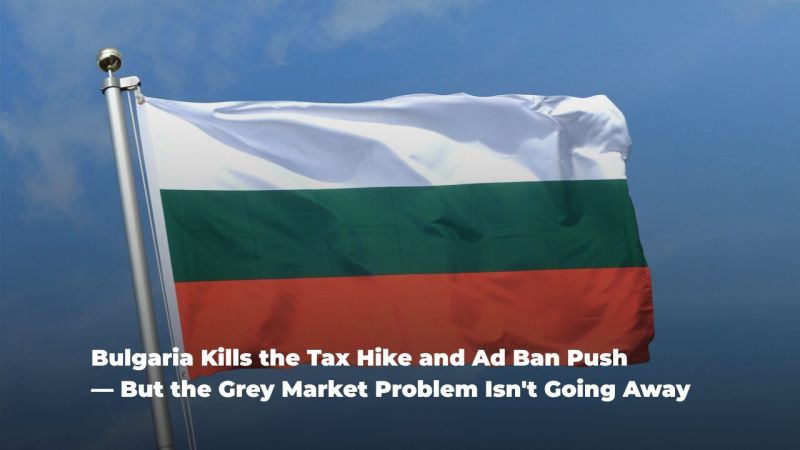
- Bulgaria’s parliament rejected proposals to raise the GGR tax from 25% to 30% and introduce a near-total advertising ban, with the government citing the country’s 60% channelisation rate as the central reason.
- Deputy Finance Minister Lyudmila Petkova warned that any tax increase before addressing the grey sector would drive players toward unlicensed operators rather than reduce harm.
- The Finance Ministry has launched a full revision of Bulgaria’s Gambling Act, while the 2026 budget introduces a new affiliate licensing and levy framework estimated to generate €100 million annually.
Sofia’s budget committee did not just hold a procedural vote this week. The Bulgarian parliament rejected opposition calls for a dramatic increase in gambling taxes and expansion of the advertising ban as officials refused to take any more action on an industry that is under pressure from various sides. The opposition has accused the ruling coalition of protecting an industry that they are promising to reform.
The broader measures were stopped. The political row was not.
What Parliament Just Refused to Do?
Democratic Bulgaria wanted the gross gaming revenue tax lifted from the current 25% to 30%, alongside changes that would have nearly doubled operator licensing fees. Their opposition counterparts, We Continue the Change, pushed a different angle: near-total advertising restrictions in densely populated areas, going far past what the 2024 rules already require. Parliament passed some minor targeted measures and rejected everything else. The government’s objection was not to the politics of it; it was to the mechanics. Tightening the screws on licensed operators without first addressing the unlicensed alternatives, ministers argued, is not reform; it is a transfer.
Bulgaria’s online gambling GGR tax climbed from 20% to 25% earlier this year, sitting alongside a 10% corporate tax. Pushing that figure to 30% inside the same budget cycle, the government said, is precisely the kind of move European market history keeps warning against.
Petkova’s Warning: The Numbers Don’t Lie
Deputy Finance Minister Lyudmila Petkova was the clearest voice in the room. Before the budget committee, she drew the connection between tax rates and illegal market growth with a directness the sector has been pushing for.
“Yes, the proposal to increase [taxes] sounds very good, but any increase before taking measures to limit the grey sector means shifting players from the legal to the illegal market,” Petkova stated.
Behind the warning sit figures the government has not been shy about. Bulgaria’s channelisation rate stands at roughly 60%, meaning around 40% of all gambling activity flows through channels that pay no tax and answer to no regulator. Petkova noted that most European countries apply rates between 20% and 25%, and departures from that range push grey sector participation upward, reliably.
The concern has data behind it. Yield Sec estimated that illegal operators captured roughly 87% of GGR in Bulgaria in 2023, leaving the regulated market with around €562 million. By the first half of 2024, that illegal share had risen to 91%. Putting another tax increase on top of a legal market already that narrow would not contain harm; it would push it somewhere regulators cannot follow.
“Enough with This Hypocrisy”
Neither opposition bloc accepted that verdict quietly. Venko Sabutev of We Continue the Change brought his frustration into the open during committee discussions, targeting what he described as a deliberate inconsistency in how transitional provisions get applied.
“How could you change the Labour Code through transitional and final provisions, but not be able to change the Gambling Act and stop gambling advertising through the same mechanism?” he demanded. “Enough with this hypocrisy.”
Democratic Bulgaria and We Continue the Change have proposed different fixes; one leaning on tax, the other on advertising controls. Their split after April’s elections sharpened those differences. Both still converge on one point: the government’s current approach is not producing results.
The Gambling Act Revision the Government Quietly Confirmed
What the government did bring was something beyond a procedural refusal. Petkova confirmed the Finance Ministry has launched a full revision of Bulgaria’s Gambling Act, describing the existing law as a product of years of piecemeal amendments dropped between readings of unrelated legislation.
“We are starting work on a comprehensive review of the Gambling Act,” she said. “The reason is that amendments are regularly made to it between the first and second readings of other laws, and then years are needed to correct the consequences of the inaccuracies.”
The National Revenue Agency, which holds regulatory responsibility under the Finance Ministry, will be part of that process. The agency has been without a Director of Gambling Policies since Alexander Popov left the role in June, adding another layer of uncertainty to a sector already navigating considerable change.
A New Levy on Affiliates, Moving Through the Budget
While parliament was making noise rejecting the opposition proposals, something quieter was moving through the same 2026 budget. A new licensing framework for gambling affiliates carries a fixed €6,000 annual charge alongside a 10% variable levy on commissions from promotional activity. Officials put the expected annual yield at around €100 million, with the framework also intended to tighten oversight of affiliate networks operating alongside licensed operators.
The wider budget projects a 5.7% deficit, roughly €7.2 billion, set against €49.5 billion in anticipated revenues and €56.8 billion in expenditure. The affiliate levy sits among several targeted measures meant to strengthen state income without applying the pressure the government says would be counterproductive on the core operator side.
What 2024’s Ad Ban Actually Did to the Market?
This attempt at imposing more stringent measures runs counter to an impressive track record. On April 30, 2024, the Bulgarian Parliament adopted by unanimous vote a law banning all gambling ads in television, radio, print, and online publications. The exception was made for the state company Bulgarian Sports Totalisator. Billboards were still permitted but with numerous restrictions: minimum distance of 300 meters from schools, universities, playgrounds, and other restricted areas, with no less than 10% of the ad space reserved for warning against risks involved. The area of gambling venue promotional material on facades was limited to 50 square meters or 20%.
Those rules are a bit hard. Mark Chakravarti, investments director at Sportingwin, told iGB in October 2024 that the revenue impact was neither gradual nor ambiguous.
“Global research shows that when they have these bans put in place, especially limiting TV commercials, there is a drop of 20% revenue in the next two months,” he said. “I think it’s been very similar in the Bulgarian market.”
Sesame, 8888, and Winbet all logged double-digit falls in website traffic after the ban took effect. Entain’s Bwin, operating in Bulgaria since 2016, saw traffic decline by as much as 17%. Betway and Betfair had already gone before the 2024 rules arrived. The industry’s position has never been that regulation is wrong. It is that tighter rules applied to licensed operators, with no matching action against unlicensed ones, do not reduce gambling; they redirect it.
Expert Analysis
Bulgaria’s regulatory bind will not be resolved by a vote that says no. The government was right to block proposals that would have squeezed a legal market already operating with 40% of total gambling activity outside its boundaries; that is not a channelisation problem you solve by taxing the 60% who stayed. Rejecting the opposition plan is not a strategy in itself. The Gambling Act revision Petkova announced is the only instrument with the scope to address how enforcement actually functions, rather than just how taxes are levied. Its value will be judged entirely by whether it produces a framework that holds together under pressure, rather than one that generates the next round of corrective amendments. The affiliate levy buys the government some revenue credibility. What it needs next is enforcement credibility. Until the grey market share starts moving in the right direction, Bulgaria’s parliament will keep having this same argument.
 Share
Share


 175 views