





Key Points
- According to a SustainoMetric report in July 2026 on behalf of Alliance for Gambling Reform, the 20 largest Australian super funds have A$14.8bn invested in equities related to gambling, with AustralianSuper having the largest share at A$4.9bn.
- None of the 20 largest superfunds got the highest rating of the report in terms of their investment responsibility, while eight fell under the ‘Limited’ category, indicating there was significant discrepancy in the ethical policy and investment practices.
- The two federal gambling reform bills proposed in parliament on 2 July 2026 focused on gambling advertisement and illegal gambling operators, but left superannuation investment regulations completely alone.
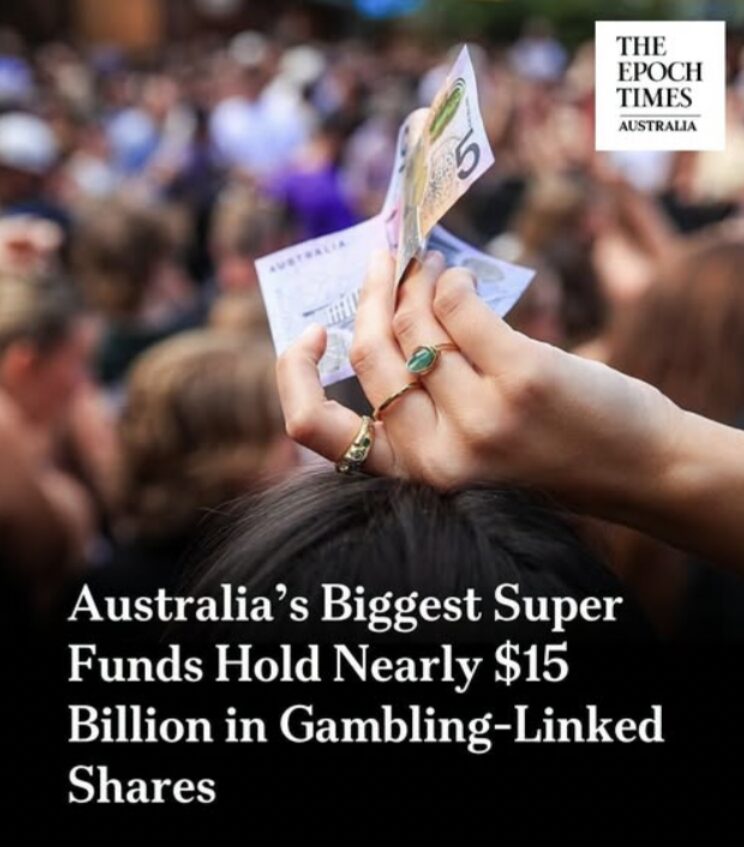
Australia’s 20 Biggest Super Funds Are Sitting on A$14.8bn in Gambling Stocks
Each payday, millions of Australians make compulsory superannuation payments without any say in what happens to their money. A report published on 23 July 2026 makes this apathy pretty costly. The top 20 super funds in Australia collectively have A$14.8bn worth of gambling-related shares in the stock market, according to research conducted by SustainoMetric, a data company specializing in sustainability, for the Alliance for Gambling Reform.
This report, entitled Bad Bets: How our superannuation companies are investing in gambling stocks, looks into the direct equity investments and responsible investment practices among the 20 super funds. There are investments in 198 listed gambling-related companies. In total, the 20 super funds have approximately A$1.18tn in listed equities, and the gambling-related shares constitute around 1% of that portfolio. Small in numbers but not in context.
What the Numbers Actually Reveal?
AustralianSuper carries the heaviest exposure at A$4.9bn, more than double any other fund on the list. Australian Retirement Trust follows at A$1.77bn, with Colonial First State at A$1.46bn, UniSuper at A$1.11bn, and Aware Super rounding out the top five at A$940m.
Pokies manufacturer Aristocrat Leisure is among the companies drawing consistent retirement-fund investment. Its listing on the ASX makes it a natural portfolio inclusion for funds not operating an explicit exclusion screen.
The A$14.8bn figure may understate the problem. SustainoMetric’s methodology excluded bonds, private equity, and externally managed funds. It also left out diversified businesses whose gambling revenue fell outside its classification criteria. The study’s own warning is pointed: current disclosure requirements make it impossible to determine the full extent of gambling exposure across the sector.
Fund-by-Fund Scores Expose the Responsible Investment Gap
When SustainoMetric judged each individual fund using the responsible investment index based on policy commitment, investment screen, stewardship, transparency, and reporting, the outcome was unequivocal. Not one fund scored at the “Leading Practice” level, which is defined as 80 to 100 on the report. Six were designated “Advanced,” while six others fell into the “Basic” category. Eight more were ranked “Limited.”
HESTA recorded the highest policy score at 68. REST and UniSuper both scored 65. AustralianSuper came in at 57. The report found gambling risks were most often addressed only through ethical investment options, leaving mainstream default funds largely untouched.
For most workers, the default balanced fund is where their super sits. Ethical sub-options are rarely selected, rarely promoted, and rarely match the scale of assets held in the default product.
What the Alliance Is Saying, and What AustralianSuper Said Back?
Martin Thomas, head of the Alliance for Gambling Reform, minced no words while addressing the Australian Associated Press. The problem of gambling is a “blind spot” for superannuation firms, according to him, and would shock many Australians to know how much of their hard-earned money ends up there.
“There’s starting to be a realisation just of how socially damaging gambling is,” Thomas told AAP. “We see bankruptcies, mental health issues, marriage break-ups.”
His broader argument is structural: gambling harm is not being treated with the same investment-level seriousness as tobacco or alcohol, both of which are routinely screened out of super portfolios. The Alliance wants funds to apply measurable screening thresholds across whole-of-fund portfolios, standardise their disclosure, and publicly report aggregate gambling exposure.
Thomas also argued the case practically. Gambling represents a fraction of most funds’ total assets, meaning there is real financial room to divest. “There is so much opportunity out there for them to do the right thing,” he said.
AustralianSuper responded by confirming that, apart from its Socially Aware investment option, it does not apply investment screens to gambling companies. The fund’s stated position is that its primary obligation is delivering strong retirement outcomes, with ongoing engagement with ASX-listed gambling businesses on governance and responsible gaming practices.
That position is not unusual. It is, arguably, the industry standard. That is the problem the report is trying to name.
Canberra Is Moving, But Not on This
On 2 July 2026, two legislative bills were tabled before parliament. These include the Interactive Gambling Amendment (Gambling Reform) Bill 2026, which forbids the advertisement of wagering on live sporting events and imposes further restrictions on advertisements via television, radio, and the Internet. The majority of these statutes will come into effect on 1 January 2027.
The legislation generated immediate criticism. Independent MP Andrew Wilkie called the bill a product of a parliament that was, in his words, “a fellow traveller with the gambling companies, the media companies and the sporting codes who are like jackals feeding on the carcass of gambling addicts.” Liberal MP Simon Kennedy described it as “a capitulation to the gambling lobby.”
None of that debate, heated as it is, touches superannuation investment rules. The reform package is aimed squarely at operators, advertising, and consumer protection. How compulsory retirement savings are invested in gambling businesses sits completely outside its scope. That gap is precisely what gives the SustainoMetric report its wider weight. It shifts part of the reform conversation from gambling products toward the capital that sustains them.
The Political Backstory: Years of Promises, Narrower Outcomes
However, this is not the first time that there has been a call for reforms. Back in February 2025, Senator David Pocock urged the Senate to investigate the influence of gambling companies on government policies, drawing on statistics provided by the Australian Electoral Commission that showed that the alcoholic and gambling companies had contributed A$2.4 million to political parties between 2023 and 2024, with 61% of the total contribution being made to the Australian Labor Party and 38% to the Liberal National Party.
In a 2023 inquiry initiated in Parliament by Peta Murphy, a former Labor MP who had since died, 31 recommendations were made, one of which was for the introduction of phased banning of gambling advertising along with a national regulator. Activists against gambling maintain that only some of the recommendations made by the Murphy Inquiry were implemented in the 2026 legislation.
Separate Roy Morgan data published before the SustainoMetric report showed that at least 3.32 million Australians experience some level of gambling-related harm, with around 2.86 million affected by their own gambling and another 1.18 million experiencing harm from someone else’s. Australia loses more per capita to gambling than any other country, approximately A$32 billion a year.
Against that backdrop, the discovery that compulsory retirement savings are helping fund the industry creates a specific political difficulty. Consumer controls and investment rules are handled by different policy levers, and so far, only one lever is being pulled.
Expert Analysis
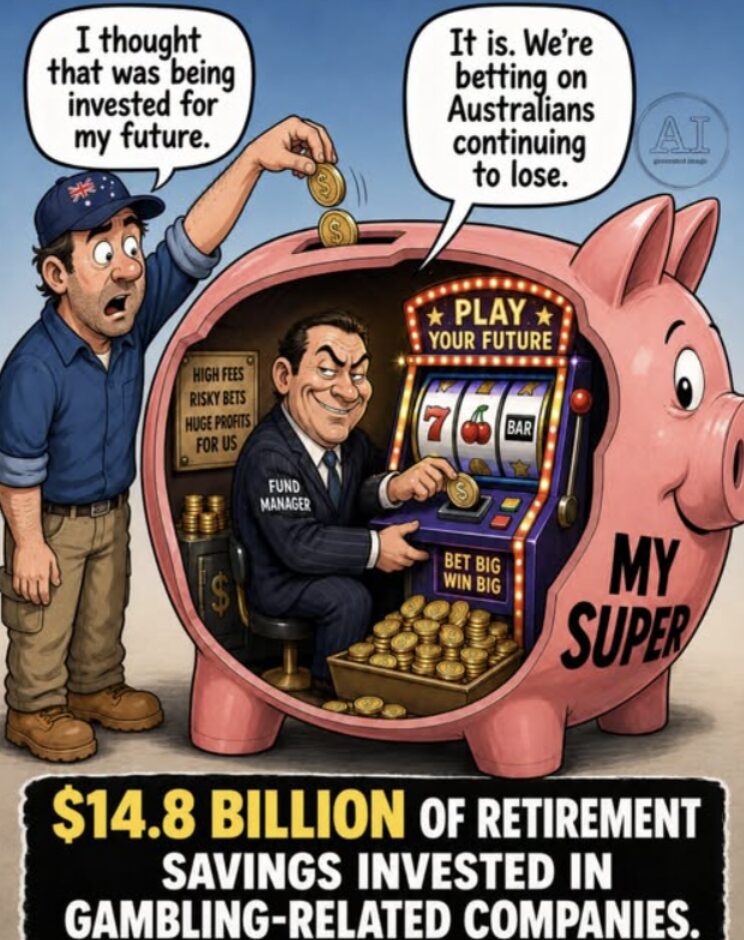
The SustainoMetric findings do more than quantify a portfolio problem. They expose a structural contradiction at the heart of Australian gambling policy. A government can restrict how gambling is advertised, strengthen self-exclusion tools, and crack down on illegal operators, yet leave intact the financial architecture that sustains the industry. Superannuation is that architecture. With A$14.8bn in gambling stocks sitting across the country’s 20 largest funds, and with not a single fund meeting best-practice standards on responsible investment, the pressure is no longer just on operators to change behaviour. It falls on fund trustees, and eventually on legislators, to decide whether compulsory retirement savings should continue to flow into an industry the same government is simultaneously trying to reform.
 Share
Share


 160 views